Finding a reliable manufacturer of calcium carbonate in India is not simply about comparing quotations. Industrial buyers must confirm whether the supplier can provide the right grade, stable quality, complete documentation and dependable bulk delivery.
The challenge becomes greater when applications have strict requirements. Calcium carbonate for food, pharmaceuticals, toothpaste, plastics, paints, paper and rubber cannot always be supplied using the same specification.
A material that performs well in PVC may not be suitable for tablets or oral-care formulations. Differences in purity, particle-size distribution, moisture, brightness, bulk density and surface treatment can directly affect manufacturing performance.
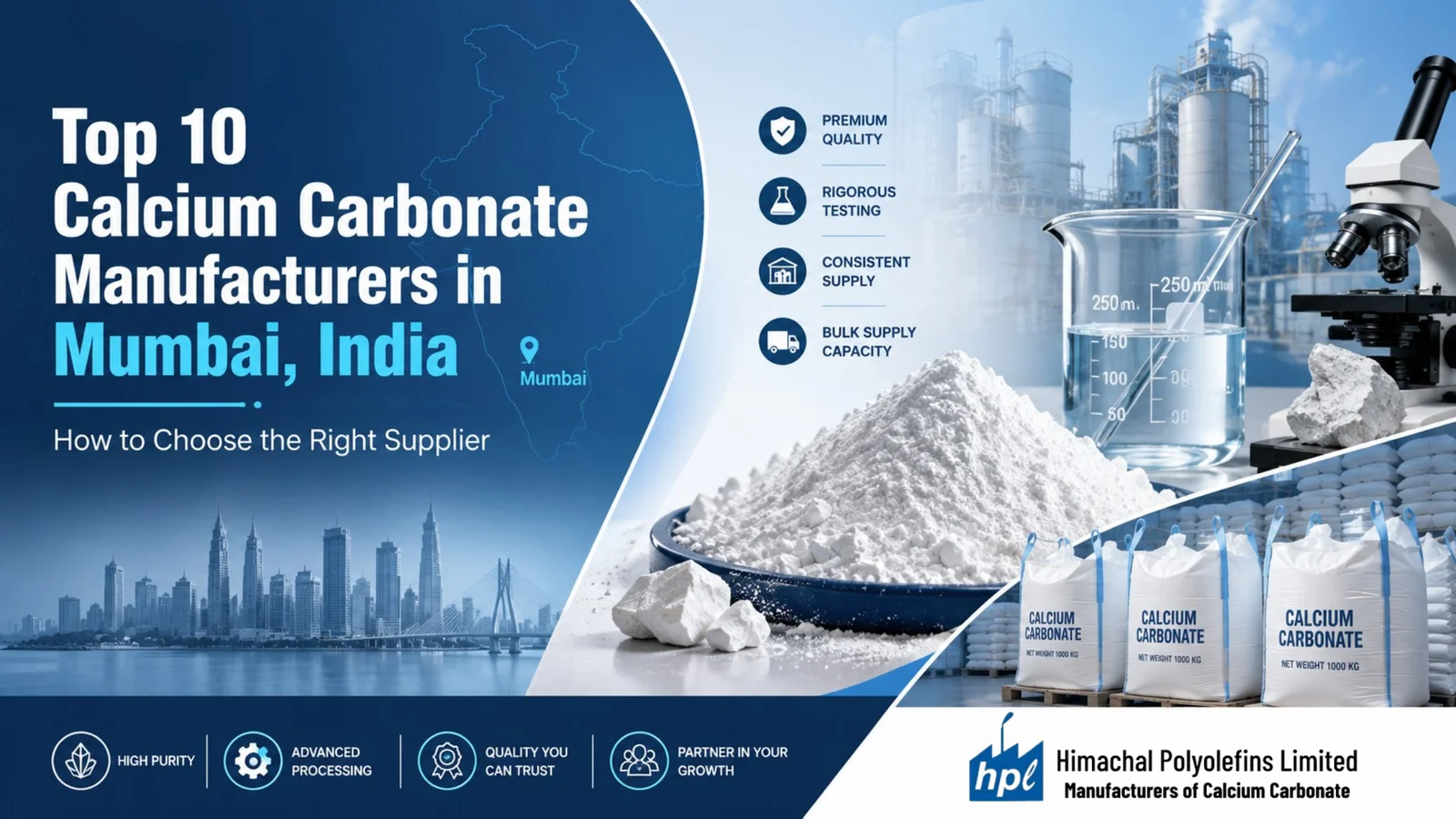
This guide reviews ten calcium carbonate manufacturers and suppliers that buyers in Mumbai may research. It also explains how to evaluate a calcium carbonate manufacturer in Mumbai, compare PCC and GCC, understand pricing and select application-specific calcium carbonate.
For procurement teams, the objective should be clear: choose a supplier based on verified specifications and process compatibility, not only brand claims or the lowest quoted price.
Which Are the Top Calcium Carbonate Manufacturers in Mumbai and India?
The right calcium carbonate supplier depends on the required grade, application, quantity, documentation and delivery schedule. Buyers commonly research companies such as Himachal Polyolefins Limited, Lime Chemicals, Kunal Calcium, 20 Microns, Wolkem India, Gulshan Polyols, Yamuna Calcium, Bhagvati Minerals, Vinipul Inorganics and Sudarshan Group before requesting samples and technical quotations.
Quick Summary
Do not treat a “top 10” list as a final supplier approval. Verify the required grade, Certificate of Analysis, particle-size distribution, manufacturing capacity, certifications, sample performance and supply reliability before placing a bulk order.
What Is a Calcium Carbonate Manufacturer?
A calcium carbonate manufacturer produces or processes calcium carbonate into grades suitable for industrial or regulated applications.
Calcium carbonate has the chemical formula CaCO₃. It is generally supplied as Ground Calcium Carbonate, Precipitated Calcium Carbonate, coated calcium carbonate, uncoated calcium carbonate or specialised food, pharmaceutical and direct-compression grades.
A GCC calcium carbonate manufacturer processes naturally occurring limestone or calcite through crushing, grinding, classification and, when required, surface coating.
A PCC manufacturer in India produces calcium carbonate through a controlled precipitation process. This allows greater control over particle shape, particle size and certain performance properties.
Specialised manufacturers may also supply:
- Food-grade calcium carbonate
- Pharma-grade calcium carbonate
- Direct compressible calcium carbonate
- DC-grade calcium carbonate granules
- Coated GCC for polymer applications
- Uncoated GCC for general industrial use
- Application-specific PCC
- Low-iron limestone powder
Top 10 Calcium Carbonate Manufacturers Buyers Can Research
The following companies have a publicly visible presence in calcium carbonate manufacturing or supply. The order is not an independent quality ranking.
1. Himachal Polyolefins Limited—HIMPOL
Himachal Polyolefins Limited, also searched as Himachal Polyolefins Ltd, Himachal Polyolefins and HIMPOL, supplies PCC, GCC, coated and uncoated grades, food-grade calcium carbonate and direct-compression products.
The company publicly lists certifications and licences including ISO 9001:2015, ISO 14001:2015, ISO 45001:2015, FSSC 22000, FSSAI, WHO-GMP, cGMP, Halal and other application-relevant credentials. Buyers should confirm the current scope and validity of each document for the required product.
HIMPOL has a Mumbai presence, while manufacturing-related searches may also refer to Himachal Polyolefins Limited Kala Amb.
2. Lime Chemicals Limited
Lime Chemicals has a Mumbai office and publicly identifies PCC, limestone powder and related calcium carbonate products among its manufacturing competencies. It may be relevant to buyers researching precipitated calcium carbonate manufacturers in India.
3. Kunal Calcium Limited
Kunal Calcium publicly presents itself as a manufacturer and exporter of PCC and GCC. Its website states that the business began with PCC and later expanded its ground calcium carbonate capacity.
4. 20 Microns Limited
20 Microns offers calcium carbonate within a broader industrial-minerals portfolio. Buyers looking for calcium carbonate for industrial use may evaluate its grades alongside technical and logistics requirements.
5. Wolkem India Limited
Wolkem publicly lists GCC, wet-ground calcium carbonate, PCC, limestone and other industrial minerals within its product portfolio.
6. Gulshan Polyols Limited
Gulshan Polyols manufactures calcium carbonate products and has publicly described experience with on-site PCC and GCC plants. This may be relevant to large paper and industrial users requiring integrated supply arrangements.
7. Yamuna Calcium
Yamuna Calcium publicly lists PCC, GCC and wet-ground calcium carbonate among its product categories. Buyers should evaluate the available grade against their plant trial and documentation checklist.
8. Bhagvati Minerals
Bhagvati Minerals markets different mesh sizes and calcium carbonate powder for industries such as plastics, paints and pharmaceuticals. Its website indicates that the manufacturing facility is in Gujarat, although the business targets buyers in Mumbai and Maharashtra.
9. Vinipul Inorganics
Vinipul Inorganics publicly offers calcium carbonate and describes GCC and PCC options for different industrial requirements.
10. Sudarshan Group
Sudarshan Group lists PCC, GCC and coated calcium carbonate grades. Buyers can include the company in an initial supplier comparison before assessing samples, specifications and commercial terms.
Why Is Choosing the Right Calcium Carbonate Supplier Important?
The calcium carbonate grade can influence processing efficiency, appearance, stability and final-product quality.
Bulk buyers should evaluate suppliers because:
- Purity requirements vary by application.
- Particle size affects dispersion and surface finish.
- Moisture can create processing and storage problems.
- Whiteness and brightness influence colour-sensitive products.
- Bulk density affects handling and formulation calculations.
- Surface treatment affects compatibility with polymers.
- Inconsistent batches can interrupt production.
- Incomplete documents can delay quality approval.
- Poor packaging may cause contamination or moisture exposure.
- Unreliable delivery can create raw-material shortages.
A calcium carbonate supplier with quality documentation should provide product-specific information rather than only a general sales brochure.
How Do You Choose a Calcium Carbonate Manufacturer in India?

Follow this step-by-step supplier evaluation process.
Step 1: Define the Application
Specify whether the calcium carbonate will be used in:
- Food products
- Pharmaceutical formulations
- Nutraceuticals
- Toothpaste or oral care
- Plastics and masterbatch
- Paints and coatings
- Paper
- Rubber
- Cosmetics
- Construction materials
- Animal nutrition
- Sealants and adhesives
Step 2: Identify the Correct Grade
Decide whether your process requires PCC, GCC, coated GCC, uncoated GCC, food grade, pharma grade or direct compressible calcium carbonate.
Do not assume that one grade can be used across every industry.
Step 3: Create a Technical Specification
Your calcium carbonate quality checklist may include:
- Assay or CaCO₃ purity
- Particle-size distribution
- Average particle size
- Moisture content
- Whiteness
- Brightness
- Bulk density
- Oil absorption
- pH
- Heavy-metal limits
- Microbiological limits
- Surface treatment
- Applicable pharmacopoeial or food requirements
Step 4: Request Documentation
Ask for the latest:
- Certificate of Analysis
- Technical Data Sheet
- Safety Data Sheet
- Regulatory declarations
- Certification copies
- Allergen or GMO statements where relevant
- Batch traceability details
- Packaging specifications
Step 5: Test a Representative Sample
Run the sample in your actual formulation and process.
A laboratory report alone cannot confirm how the material will disperse, flow, mix, compress, coat or affect the finished product.
Step 6: Audit Supply Capability
Discuss:
- Monthly production capacity
- Standard lead time
- Minimum order quantity
- Packaging options
- Inventory planning
- Transport arrangements
- Peak-season availability
- Complaint handling
- Change-notification procedure
Step 7: Ap-prove the Supplier Commercially and Technically
Compare the landed cost, not only the price per kilogram. Include transport, rejected batches, production losses, storage requirements and possible downtime.
Industrial Calcium Carbonate Buying Checklist
Approve a supplier only after checking the grade, specification, sample performance, COA, documentation, packaging, traceability, capacity, delivery plan and total landed cost.
What Are the Benefits of Working With a Reliable Manufacturer?
A reliable calcium carbonate manufacturer can help buyers achieve:
- More consistent production
- Better batch-to-batch repeatability
- Lower risk of material rejection
- Faster incoming quality checks
- Improved traceability
- Better formulation control
- Technical support during grade selection
- More dependable bulk supply
- Clearer complaint investigation
- Better preparation for customer audits
- Reduced risk of selecting the wrong grade
- Easier planning for regular B2B supply
These benefits are especially important for regulated and high-volume manufacturing industries.
PCC vs GCC: Which Calcium Carbonate Do You Need?
| Factor | PCC | GCC |
|---|---|---|
| Full form | Precipitated Calcium Carbonate | Ground Calcium Carbonate |
| Production route | Controlled chemical precipitation | Mechanical processing of natural limestone or calcite |
| Particle control | Greater control over size and morphology | Depends on mineral source and grinding process |
| Common options | Uncoated, coated and specialised PCC | Coated, uncoated and micronised GCC |
| Typical uses | Pharma, food, oral care, paper, plastics and specialty applications | Plastics, paints, paper, rubber, construction and general industrial use |
| Cost position | Often higher because of controlled processing | Often more economical for bulk filler applications |
| Selection basis | Purity, morphology, particle size and application performance | Purity, mesh size, brightness, coating and dispersion |
The GCC vs PCC decision should be based on your product formulation and performance target.
For example, calcium carbonate for the plastics industry may require a coated grade with good polymer compatibility. Calcium carbonate in toothpaste may require controlled purity, abrasivity and particle characteristics.
Who Needs an Application-Specific Calcium Carbonate Supplier?
An application-specific calcium carbonate manufacturer is suitable for:
- Food manufacturers needing food-grade calcium carbonate
- Pharmaceutical companies requiring pharmacopoeial compliance
- Nutraceutical manufacturers producing calcium supplements
- Oral-care brands using calcium carbonate in toothpaste
- Plastic manufacturers producing PVC, masterbatch or compounds
- Paint manufacturers requiring controlled brightness and particle size
- Paper mills using calcium carbonate as filler or coating material
- Rubber manufacturers seeking consistent reinforcement or filler properties
- Cosmetic manufacturers requiring controlled purity
- Construction-product manufacturers using mineral fillers
- Animal-nutrition businesses requiring suitable calcium sources
- Procurement teams buying calcium carbonate in large quantities
What Factors Affect Calcium Carbonate Pricing?
The price of calcium carbonate for bulk supply can vary according to:
- PCC, GCC or specialised grade
- Purity and impurity limits
- Particle size and classification
- Coated or uncoated treatment
- Food, pharma or industrial requirements
- Testing and documentation
- Order quantity
- Packaging type
- Transport distance
- Delivery frequency
- Custom specifications
- Raw-material and energy costs
- Inventory or safety-stock requirements
A lower quotation may not produce a lower manufacturing cost. Poor dispersion, inconsistent particle size, moisture or repeated batch rejection can make a cheap grade more expensive in practice.
Which Calcium Carbonate Trends Are Important in 2026?
Greater Demand for Application-Specific Grades
Buyers are moving away from generic descriptions such as “white calcium carbonate powder.” Purchase specifications increasingly focus on measurable properties and end-use performance.
Stronger Batch Traceability
Procurement and quality teams increasingly expect labels, COAs, batch numbers and dispatch records to match clearly.
Digital Technical Documentation
Digital COAs, controlled document versions and faster retrieval of batch records are becoming more important for supplier approval.
More Attention to Particle-Size Distribution
Buyers are evaluating the complete distribution rather than relying only on one average particle-size value.
Increased Environmental Scrutiny
ISO published ISO 14001:2026 in April 2026, with stronger attention to environmental conditions, resource efficiency, climate change and value-chain impacts. Industrial buyers may increasingly ask suppliers how environmental controls are managed.
ISO 9001 Transition Planning
ISO states that the revised ISO 9001 is expected to replace ISO 9001:2015 in September 2026. Buyers should check the current validity of supplier certificates and, where relevant, ask about transition planning.
Better Packaging and Monsoon Protection
Mumbai and pan-India buyers are paying greater attention to liners, bag sealing, pallet protection, storage conditions and moisture exposure during transport.
Why Choose Himachal Polyolefins Limited in Mumbai, India?
Himachal Polyolefins Limited is positioned as a calcium carbonate manufacturer in Mumbai | India serving industrial and regulated applications.
The HIMPOL product portfolio publicly includes:
- Precipitated Calcium Carbonate
- Ground Calcium Carbonate
- Coated GCC
- Uncoated GCC
- Food-grade calcium carbonate
- Pharma-oriented grades
- Direct Compression granules
- Application-specific calcium carbonate products
The company also publicly lists a combination of quality, food-safety, environmental, occupational-safety and pharmaceutical-related credentials. Buyers should request current certificates, product specifications and batch-specific documents during vendor approval.
HIMPOL may be considered by businesses looking for:
- A manufacturer of calcium carbonate in Mumbai
- A calcium carbonate supplier in India
- PCC and GCC calcium carbonate supply
- Food and pharma-grade options
- Calcium carbonate for bulk orders
- Regular B2B supply
- Technical documentation
- Multiple application-specific grades
The right final grade should always be selected after reviewing the specification and completing a production trial.
Frequently Asked Questions
1. How do I choose a calcium carbonate manufacturer in India?
Check the required grade, purity, particle-size distribution, moisture, whiteness, documentation, certifications, production capacity and delivery reliability. Request a sample and test it in your actual manufacturing process before approving bulk supply.
2. What should bulk buyers check before buying calcium carbonate?
Bulk buyers should check the COA, Technical Data Sheet, Safety Data Sheet, batch consistency, packaging, traceability, lead time and supplier capacity. They should also confirm that the offered material matches the approved sample.
3. What is the difference between PCC and GCC calcium carbonate?
PCC is produced through controlled precipitation, allowing greater control over particle characteristics. GCC is manufactured by grinding and classifying natural limestone or calcite. The correct choice depends on performance, purity, particle size, surface treatment and cost.
4. Which calcium carbonate grade is suitable for plastics?
Calcium carbonate for plastics may be coated or uncoated depending on the polymer, loading level and processing method. PVC, masterbatch and polymer compounds often require controlled particle size, low moisture and good dispersion.
5. What documents are required for bulk calcium carbonate supply?
Common documents include a Certificate of Analysis, Technical Data Sheet, Safety Data Sheet, certification copies, regulatory declarations, batch-traceability records and packaging specifications. Food and pharmaceutical applications may require additional product-specific declarations.
Choose the Right Calcium Carbonate Supplier for Your Application
Selecting a calcium carbonate manufacturer in India requires more than finding a company that can supply white powder at a competitive rate.
The right supplier should understand your application, provide a suitable PCC or GCC grade, maintain calcium carbonate batch consistency and support every shipment with clear documentation.
For PCC, GCC, coated, uncoated, food-grade, pharma-oriented or direct-compression requirements, contact Himachal Polyolefins Limited—HIMPOL to discuss your specification, required quantity, packaging and delivery schedule.
Request a technical specification, representative sample and quotation for your next bulk calcium carbonate requirement.