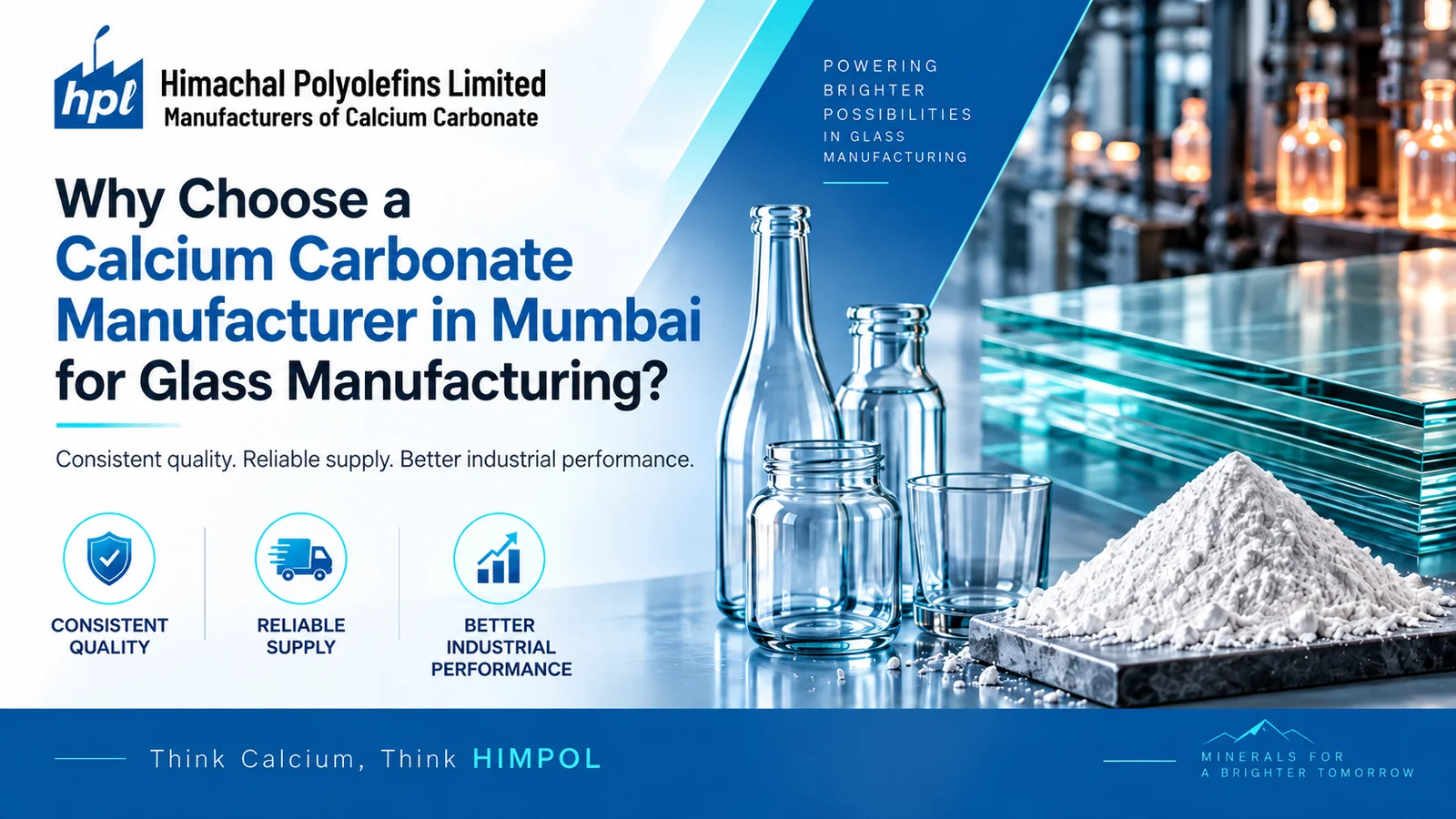
Glass manufacturing depends on precision. A small variation in raw-material purity, particle size, moisture, or supply consistency can affect melting behaviour, production efficiency, and the quality of the finished glass. That is why choosing the right calcium carbonate source matters more than simply comparing prices.
For glass manufacturers, calcium carbonate is an important mineral raw material because it introduces calcium into the glass formulation. During the melting process, calcium carbonate decomposes and contributes calcium oxide, which helps improve the chemical durability and stability of many glass compositions.
Working with reliable Calcium Carbonate manufacturers in Mumbai | India can also make procurement easier for businesses that need steady industrial quantities and consistent specifications.
Himachal Polyolefins Limited (HIMPOL) manufactures different calcium carbonate grades for industrial applications. Whether a buyer is comparing a Calcium Carbonate manufacturer in Mumbai, evaluating calcium carbonate manufacturers in India, or looking for a dependable supplier for long-term production, quality consistency should remain the priority.
What Is the Role of Calcium Carbonate in Glass Manufacturing?
Calcium carbonate is used in glass manufacturing as a source of calcium oxide. During high-temperature melting, calcium carbonate decomposes and contributes calcium oxide to the glass formulation. Calcium oxide helps improve chemical durability, stability and overall performance, making consistent calcium carbonate quality important for reliable glass production.
Calcium carbonate, commonly represented as CaCO₃, is widely used across industrial applications. One important calcium carbonate industrial use in Mumbai | India is its role as a mineral raw material in glass production.
In a typical glass batch, calcium carbonate works alongside materials such as silica and soda ash. When the batch reaches high temperatures, calcium carbonate releases carbon dioxide and leaves calcium oxide behind.
Calcium oxide acts as a stabilising component in many glass formulations. Without the right balance of stabilising materials, glass may not achieve the desired durability or resistance needed for its intended application.
This is one reason manufacturers pay close attention to raw-material consistency rather than asking only, “what is the use of calcium carbonate?”
: In glass manufacturing, calcium carbonate is not simply added as a powder. It serves as an important calcium source that contributes to the chemistry and stability of the final glass formulation.
Why Is Calcium Carbonate Important for Glass Manufacturing?
Glass production involves high temperatures and tightly controlled formulations. Even when the recipe is correct, inconsistent raw materials can create unnecessary production challenges.
Important reasons for selecting consistent calcium carbonate include:
- Calcium source: Calcium carbonate provides calcium oxide after decomposition during melting.
- Chemical durability: Calcium oxide contributes to the stability and durability of many common glass formulations.
- Batch consistency: Controlled mineral characteristics help manufacturers maintain more predictable production conditions.
- Raw-material uniformity: Variations in purity, moisture and particle distribution can affect how materials behave during processing.
- Reliable procurement: A dependable Calcium Carbonate manufacturer in India can help businesses maintain regular production schedules.
- Industrial-scale availability: Glass plants often require consistent volumes, making dependable supply especially important.
For a production team, an inconsistent batch can mean more than a technical inconvenience. It may lead to extra adjustments, process delays, or additional quality checks. Choosing raw materials carefully can reduce such uncertainty.
How Does Calcium Carbonate Work During the Glass Manufacturing Process?

The exact glass-making process varies according to the type of glass being produced, but the basic role of calcium carbonate can be understood step by step.
Step 1: Raw materials are selected
Glass manufacturers choose materials according to the required formulation. Silica is typically a major glass-forming component, while soda ash and calcium-containing minerals perform other important functions.
Calcium carbonate must meet the manufacturer’s required quality parameters before entering production.
Step 2: The materials are measured and blended
Each ingredient is weighed according to the formulation and mixed to create a relatively uniform glass batch.
Uniform mixing is important because inconsistent raw-material distribution may affect melting and finished-product consistency.
Step 3: The batch enters the furnace
The mixture is heated to very high temperatures. During this stage, calcium carbonate undergoes thermal decomposition.
In simplified terms:
CaCO₃ → CaO + CO₂
Calcium oxide remains within the molten glass composition, while carbon dioxide is released.
Step 4: Calcium oxide contributes stability
The calcium oxide supplied through calcium carbonate helps stabilise the glass network and contributes to the required chemical and physical performance.
Step 5: Molten glass is formed and cooled
Depending on the application, molten glass may be formed into bottles, containers, sheets or other products before controlled cooling.
Consistent raw materials support more predictable processing from one production batch to another.
What Are the Benefits of Choosing the Right Calcium Carbonate?
Working with an established Calcium Carbonate manufacturer in Mumbai can provide several practical advantages to industrial buyers.
- More consistent raw-material specifications
- Better control over calcium carbonate purity
- Reliable particle-size characteristics
- Lower risk of unexpected batch variation
- Dependable availability for recurring requirements
- Technical understanding of different calcium carbonate grades
- Easier sourcing for Mumbai and other Indian manufacturing locations
The goal is not to claim that calcium carbonate alone determines final glass quality. Glass performance depends on the entire formulation and manufacturing process.
However, dependable raw materials give production teams a stronger starting point.
Calcium Carbonate vs Other Calcium Sources for Glass Manufacturing
Different glass formulations can use different calcium-bearing raw materials. The correct choice depends on formulation requirements, chemistry, plant conditions and processing goals.
| Factor | Calcium Carbonate | Dolomite | Other Calcium-Bearing Minerals |
|---|---|---|---|
| Main role | Calcium source | Calcium + magnesium source | Depends on mineral |
| Contribution | Produces CaO during heating | Produces CaO and MgO | Depends on composition |
| Selection depends on | Purity, particle size, chemistry | Ca/Mg balance and chemistry | Specific glass requirement |
| Best suited for | Formulations requiring controlled calcium input | Formulations needing calcium and magnesium | Specialised formulations |
| Supplier consistency | Important | Important | Important |
There is no universal raw material that is best for every glass composition. Manufacturers should select materials according to technical specifications and process requirements.
Who Needs Industrial-Grade Calcium Carbonate?
Industrial calcium carbonate may be relevant to organisations involved in:
- Container glass manufacturing
- Flat and sheet glass production
- Glass bottle manufacturing
- Architectural glass
- General industrial glass products
- Construction-material manufacturing
- Other mineral-based industrial formulations
Outside glass manufacturing, calcium carbonate powder uses in Mumbai | India extend across plastics, paints, paper, rubber, pharmaceuticals, food, oral care and other sectors.
HIMPOL’s broader portfolio also includes products relevant to buyers searching for Ground Calcium Carbonate (GCC) in Mumbai | India, Direct Compressible (DC) Grade Calcium Carbonate in Mumbai, Manufacturer of Food Grade Calcium Carbonate in Mumbai | India and precipitated calcium carbonate in India.
For example, the precipitated calcium carbonate uses required in one industry can differ significantly from those required in glass production. This is why manufacturers should choose the grade according to the actual application rather than treating all calcium carbonate powders as interchangeable.
What Determines Calcium Carbonate Pricing?
There is no single standard price for every calcium carbonate requirement. Industrial pricing can vary according to several factors.
Key pricing considerations include:
- Required calcium carbonate grade
- Purity specifications
- Particle-size requirements
- Coated or uncoated material requirements
- Order quantity
- Packaging format
- Freight and delivery location
- Testing and documentation requirements
- Long-term supply volumes
A bulk calcium carbonate supplier in Mumbai, India may quote differently for a recurring industrial requirement compared with a smaller specialised order.
For procurement teams, the lowest price per kilogram should therefore not be the only deciding factor. Consistency, rejection risk, documentation and supply reliability can affect the true cost of production.
What Are the Calcium Carbonate and Glass Industry Trends in 2026?
In 2026, industrial buyers are increasingly focused on more than simply securing raw materials. Supply reliability, process efficiency and documented quality are becoming important purchasing considerations.
Glass manufacturers are also under pressure to improve operational efficiency while maintaining consistent finished-product quality. This places greater attention on controlled raw materials and dependable supplier relationships.
Another noticeable trend is stronger supplier evaluation. Buyers increasingly want clearer technical specifications, quality documentation, predictable batch characteristics and dependable logistics.
For Manufacturers calcium carbonate in Mumbai, India, this means competing on consistency and technical reliability rather than only pricing.
Specialised applications are also driving demand for clearly differentiated calcium carbonate grades. Buyers searching for precipitated calcium carbonate in India, GCC, food-grade calcium carbonate or direct-compressible grades increasingly expect a supplier to understand where each product should—and should not—be used.
Why Choose HIMPOL as a Calcium Carbonate Manufacturer in Mumbai?
Himachal Polyolefins Limited focuses on manufacturing calcium carbonate grades for multiple industrial applications.
For businesses comparing calcium carbonate manufacturers in India, HIMPOL offers a broad product portfolio that includes Ground Calcium Carbonate, Precipitated Calcium Carbonate, DC Grade and Food-Grade Calcium Carbonate.
Companies searching for a precipitated calcium carbonate manufacturer in Mumbai India can explore HIMPOL’s PCC range according to their application requirements.
HIMPOL also caters to sectors beyond glass. For example, calcium carbonate is used in oral-care formulations. Searches such as “use of calcium carbonate in dental product is” or “calcium carbonate in toothpaste in Mumbai | India” relate to a very different application and should be linked to the appropriate Oral Care application page rather than mixed with glass-grade requirements.
Similarly, HIMPOL’s DC Grade products serve specialised requirements where buyers may search for direct-compressible calcium carbonate rather than conventional industrial GCC.
That application-specific approach matters. A glass manufacturer should receive a product selected for glass-processing requirements, not simply whichever calcium carbonate grade happens to be available.
For businesses researching Calcium Carbonate production in Mumbai, india calcium carbonate production in India, or dependable Calcium Carbonate manufacturers in mumbbai | india, working directly with an experienced manufacturer can simplify technical discussions and long-term sourcing.
Mini Summary: HIMPOL supports multiple industries with application-specific calcium carbonate grades. For glass manufacturers, the focus should remain on consistent quality, suitable specifications and dependable bulk supply.
FAQs
1. What is the use of calcium carbonate in glass manufacturing?
Calcium carbonate acts mainly as a source of calcium oxide. During furnace heating, calcium carbonate decomposes into calcium oxide and carbon dioxide. The calcium oxide becomes part of the glass composition and contributes to its stability and chemical durability.
2. Which calcium carbonate is suitable for glass manufacturing?
The suitable calcium carbonate depends on the glass formulation, desired chemistry, purity requirements and processing conditions. Manufacturers should confirm specifications with their technical team and calcium carbonate supplier before selecting a grade.
3. Why should I choose a Calcium Carbonate manufacturer in Mumbai?
Working with a Calcium Carbonate manufacturer in Mumbai can help businesses in and around Mumbai access technical communication, regular industrial supply and more convenient logistics. The supplier should still be evaluated on quality consistency, specifications and documentation.
4. What is the difference between GCC and precipitated calcium carbonate?
Ground Calcium Carbonate is produced by mechanically processing naturally occurring calcium carbonate minerals. Precipitated calcium carbonate in India is manufactured through a controlled chemical precipitation process, allowing tighter control of characteristics such as particle morphology and size.
5. What are the main calcium carbonate industrial uses in Mumbai | India?
Calcium carbonate is used across glass, plastics, paints, paper, rubber, construction, pharmaceuticals, food, oral care and other industries. The appropriate grade differs by application, so buyers should select calcium carbonate according to specific technical and regulatory requirements.
Looking for a Reliable Calcium Carbonate Manufacturer in Mumbai?
Choosing calcium carbonate for glass manufacturing is not simply about sourcing another raw material. The right supplier can help you maintain consistency, understand application requirements and secure dependable quantities for ongoing production.
If you are comparing Calcium Carbonate manufacturers in Mumbai | India, calcium carbonate manufacturers in India, GCC suppliers or a manufacturer of precipitated calcium carbonate in Mumbai, India, connect with Himachal Polyolefins Limited (HIMPOL) to discuss the grade and specifications suitable for your application.
Think Calcium, Think HIMPOL.