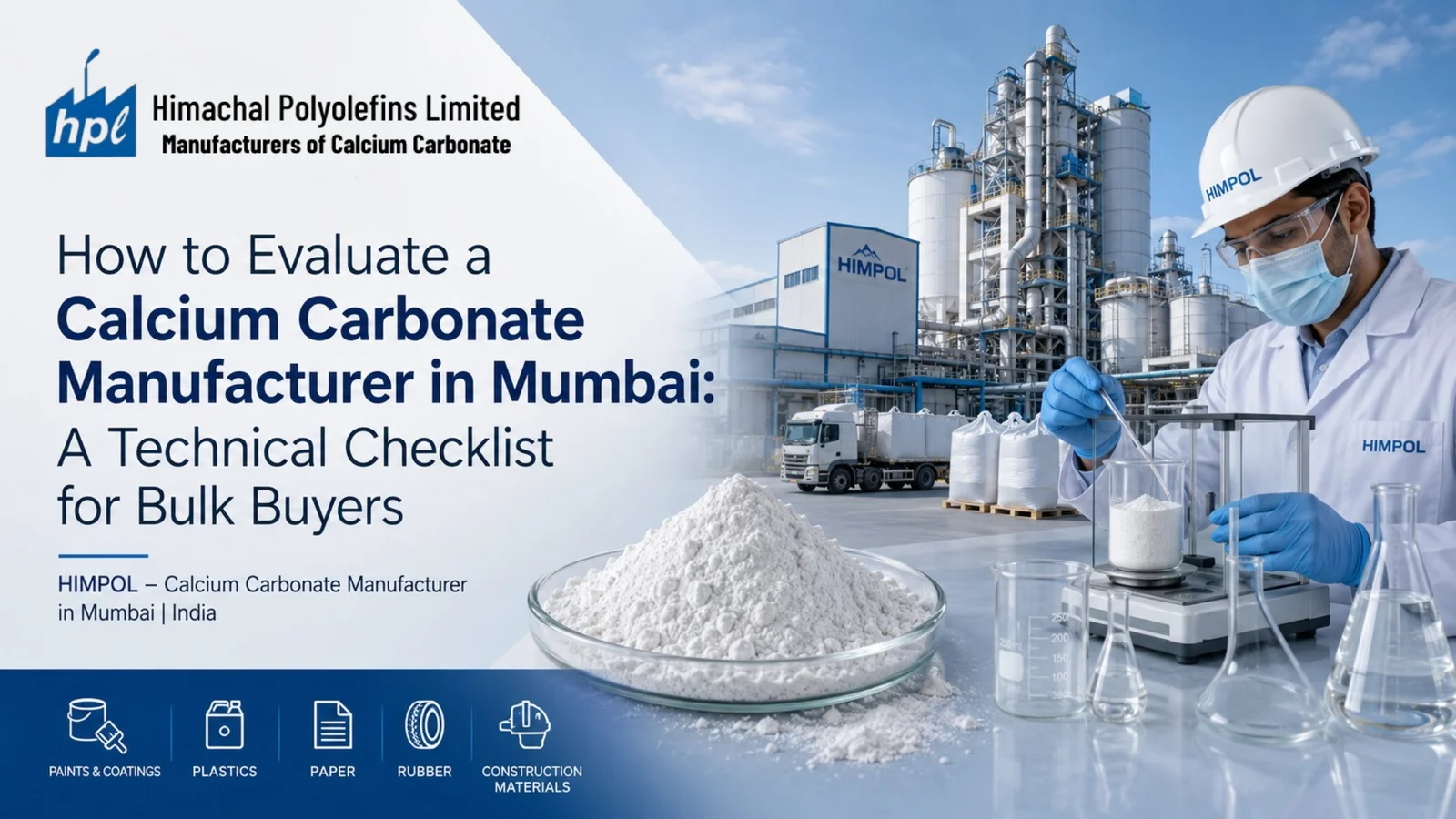
Choosing a calcium carbonate supplier is not simply a matter of comparing prices per kilogram. The material may influence processing behaviour, colour, texture, dispersion, stability, strength and the overall consistency of your finished product.
A small variation in purity, moisture or particle-size distribution can create much larger problems during production. It may affect mixing time, formulation performance, machine output, rejection levels and customer satisfaction.
That is why bulk buyers need a structured evaluation process.
When assessing a calcium carbonate manufacturer in Mumbai, buyers should examine the manufacturer’s product range, technical specifications, quality-control system, testing facilities, documentation, manufacturing capacity, traceability and delivery performance.
This guide provides a practical technical checklist to help procurement, QA, R&D and production teams make a better-informed supplier decision.
Table of Contents
- What should buyers evaluate first?
- Confirm whether the supplier is a manufacturer
- Match the calcium carbonate grade to the application
- Review technical specifications
- Check particle-size distribution
- Verify purity and moisture
- Examine the Certificate of Analysis
- Review supporting documents
- Evaluate quality testing
- Assess batch consistency
- Review certifications and compliance
- Check manufacturing and supply capacity
- Test samples before approval
- Compare manufacturers beyond price
- Common supplier-selection mistakes
- Technical checklist for bulk buyers
- Frequently asked questions
What Should Buyers Evaluate Before Selecting a Calcium Carbonate Manufacturer?
Before approving a calcium carbonate manufacturer, evaluate the following areas:
- Manufacturer identity and production capability
- Availability of the required PCC, GCC or specialised grade
- Product purity and chemical composition
- Particle-size distribution and consistency
- Moisture, whiteness and other application-specific parameters
- Certificate of Analysis and technical documentation
- In-house quality-control capabilities
- Batch traceability
- Relevant certifications
- Sample performance in your process
- Bulk supply capacity and delivery reliability
- Technical support after purchase
This list provides a useful starting point for anyone researching how to choose a calcium carbonate manufacturer in Mumbai.
1. Confirm Whether the Supplier Is a Manufacturer or Trader
The first step is to understand who is actually producing the material.
A trader may be able to source calcium carbonate from different manufacturers. However, a direct calcium carbonate manufacturer in India normally has greater control over production parameters, testing, traceability and batch consistency.
This does not mean that every trader is unsuitable or that every manufacturer is automatically reliable. It means buyers should understand the supply chain before approving a vendor.
Questions to ask
- Where is the calcium carbonate manufactured?
- Does the company own or operate the production facility?
- Can it provide manufacturing and testing information?
- Does the company control the raw material and production process?
- Can each supplied batch be traced to its production records?
- Is the same manufacturing source used for repeat orders?
When comparing a calcium carbonate manufacturer vs trader for bulk supply, consider consistency and accountability—not only price.
A manufacturer with production control may be better positioned to investigate deviations, adjust specifications and provide application-specific technical support.
2. Match the Calcium Carbonate Grade to Your Application
Different industries do not necessarily require the same type of calcium carbonate.
A product suitable for construction materials may not meet the purity, safety or documentation requirements expected in food, pharmaceutical or oral-care applications. Similarly, a grade used in paints may not provide the dispersion or surface compatibility required in a polymer formulation.
A reliable industrial calcium carbonate manufacturer should first understand your application.
Common product categories
| Grade | General characteristics | Typical application areas |
|---|---|---|
| PCC | Controlled precipitation, particle characteristics and purity | Pharma, food, oral care, paper, paints and specialised formulations |
| GCC | Mechanically ground mineral with application-dependent particle sizes | Plastics, rubber, paints, construction, paper and fillers |
| Coated calcium carbonate | Surface-treated for improved compatibility | Plastics, masterbatch, PVC, rubber and polymers |
| Food-grade calcium carbonate | Produced and tested for intended food use | Food fortification and permitted food applications |
| Pharmaceutical-grade calcium carbonate | Manufactured against applicable pharmacopoeial or customer specifications | Tablets, supplements, antacids and pharmaceutical formulations |
| Directly compressible grade | Engineered for compression and formulation performance | Tablet manufacturing |
| Application-specific grade | Tailored to defined technical requirements | Specialised industrial processes |
A capable PCC manufacturer in India should explain how its precipitated grade differs from its ground or coated products. Similarly, a GCC manufacturer in India should clarify available particle sizes, surface-treatment options and target applications.
The correct question is not, “Which calcium carbonate is best?”
It is, “Which calcium carbonate specification is suitable for our process and final product?”
3. Review the Technical Specification Before Discussing Price
A quotation without a clear specification provides limited value.
Before comparing commercial terms, request the product’s technical data and identify which parameters are guaranteed, typical or tested only on request.
Important calcium carbonate technical specifications may include:
- Calcium carbonate assay
- Calcium content
- Particle-size distribution
- Average particle size
- Top-cut particle size
- Moisture or loss on drying
- Whiteness
- Brightness
- Bulk density
- pH
- Oil absorption
- Residue on sieve
- Acid-insoluble matter
- Heavy metals
- Specific surface area
- Surface treatment
- Microbiological limits, where applicable
- Compendial or regulatory compliance, where required
Not every parameter is equally important for every application. Buyers should therefore prepare an approved raw-material specification based on process requirements rather than accepting a generic product description.
Expert tip
Classify every parameter as:
- Critical: Failure can affect safety, compliance or production
- Major: Variation can influence product performance
- Informational: Useful for monitoring but not always a rejection criterion
This makes supplier comparison more objective.
4. Examine Calcium Carbonate Particle-Size Distribution
Particle size is often described using a single micron value or mesh number. However, one number may not explain the complete behaviour of the powder.
A useful evaluation should consider the calcium carbonate particle-size distribution, not merely a general statement such as “fine powder.”
Depending on the test method, a particle-size report may include values such as:
- D10
- D50
- D90
- Average particle size
- Top cut
- Residue on a specified sieve
D50 generally indicates the particle diameter below which 50% of the measured sample falls. D90 indicates the diameter below which 90% falls. The interpretation depends on the analytical method and reporting basis.
Why particle-size consistency matters
Particle size may influence:
- Dispersion
- Surface finish
- Texture
- Opacity
- Abrasiveness
- Flow
- Mixing time
- Viscosity
- Packing behaviour
- Polymer compatibility
- Tablet processing
- Finished-product appearance
Research on calcium carbonate also demonstrates that particle formation conditions can influence properties such as crystal size, surface area and morphology.
When searching for a calcium carbonate supplier with consistent particle size, ask for results from several batches—not only one ideal sample.
5. Verify Calcium Carbonate Purity and Moisture
Purity is an important parameter, but the required limit depends on the intended use and applicable standard.
The calcium carbonate purity percentage should be evaluated together with related parameters such as acid-insoluble matter, magnesium compounds, iron, heavy metals and other impurities relevant to the application.
Food-grade specifications may follow applicable food regulations and recognised specifications. The Joint FAO/WHO Expert Committee on Food Additives publishes identity and purity information for food-additive calcium carbonate, while Indian food businesses must evaluate applicable FSSAI requirements for their intended use.
For pharmaceutical applications, requirements should be matched with the applicable pharmacopoeial monograph, approved internal specification and regulatory commitments. The Indian Pharmacopoeia Commission explains that pharmaceutical specifications are compiled in official monographs.
Why moisture matters
Excessive or inconsistent moisture may affect:
- Powder flow
- Storage stability
- Agglomeration
- Mixing
- Packaging
- Dosage accuracy
- Polymer processing
- Final-product consistency
When deciding how to check calcium carbonate purity and moisture, confirm:
- The test method
- The specification limit
- Testing frequency
- Instrument calibration
- Sampling procedure
- Results from multiple batches
A single acceptable result does not prove long-term consistency.
6. Learn How to Read a Calcium Carbonate Certificate of Analysis
A calcium carbonate Certificate of Analysis is one of the most important documents in supplier approval.
A proper calcium carbonate COA should identify the supplied material and show the actual results of tests performed for that batch.
A useful COA should normally contain
- Manufacturer or supplier name
- Product name and grade
- Batch or lot number
- Manufacturing date
- Retest or expiry information, where applicable
- Test parameters
- Specification limits
- Actual test results
- Test methods or references
- Approval by authorised quality personnel
- Issue date
- Traceability information
How to review the COA
Do not only check whether each result says “complies.”
Compare the actual numerical results across several batches.
For example, three batches may all pass the approved moisture limit, but steadily increasing results could indicate a developing process, storage or packaging concern.
The same principle applies to assay, particle size, whiteness, bulk density and residue.
Red flags in a COA
- No batch number
- No actual numerical results
- Missing specification limits
- Identical values across every batch
- No test-method references
- Unclear manufacturer identity
- Manual alterations without authorisation
- Results that do not match the agreed specification
- A generic COA reused for different dispatches
Understanding how to read a calcium carbonate Certificate of Analysis allows procurement and quality teams to identify issues before the material enters production.
7. Request the COA, TDS and SDS

Buyers often ask, “What documents should a calcium carbonate manufacturer provide?”
At a minimum, documentation may include:
Certificate of Analysis
The COA provides batch-specific quality results.
Technical Data Sheet
The TDS explains typical product characteristics, recommended uses and general technical information.
Safety Data Sheet
The SDS provides safety, handling, storage, exposure and emergency information based on the applicable hazard-communication framework.
A calcium carbonate manufacturer with COA, TDS and SDS provides buyers with a stronger documentation foundation. However, documents should be current, internally consistent and specific to the offered grade.
Depending on the application, buyers may also request:
- Manufacturing licence information
- Certification copies
- Allergen declaration
- GMO statement
- TSE/BSE statement
- Residual solvent statement
- Heavy-metal declaration
- Microbiological specification
- Food-contact statement
- Country-of-origin declaration
- Halal or other market-specific certification
- Regulatory compliance declaration
- Product questionnaire
- Change-control commitment
Only request documents that are relevant to the material’s intended use and your quality system.
8. Evaluate In-House Quality Testing
A calcium carbonate manufacturer with in-house quality testing may respond faster to deviations and maintain better control over routine release testing.
During vendor evaluation, ask:
- Which tests are performed internally?
- Which tests are outsourced?
- Is every batch tested before release?
- Are instruments calibrated?
- Are approved test methods available?
- How are samples collected?
- How long are retention samples stored?
- How are out-of-specification results investigated?
- Are production and laboratory records linked?
- Is there a formal change-control process?
Relevant calcium carbonate quality testing may include chemical, physical and application-based evaluations.
For certain applications, Indian Standards also define requirements for specific calcium carbonate uses. Examples include standards relating to precipitated calcium carbonate for paints and cosmetic applications. Buyers should confirm the current edition, scope and applicability directly with the Bureau of Indian Standards before using any standard in a purchase specification.
9. Evaluate Calcium Carbonate Batch Consistency
A supplier may provide an excellent development sample and still struggle to reproduce the same quality during regular commercial supply.
That is why calcium carbonate batch consistency should be evaluated before long-term approval.
Review at least three commercial or pilot batches
Compare:
- Assay
- Particle-size distribution
- Moisture
- Whiteness
- Bulk density
- Oil absorption
- Residue
- pH
- Application performance
Use trend analysis
Instead of reviewing each batch separately, place results in a table or control chart. This makes gradual shifts easier to identify.
| Batch | Purity | D50 | Moisture | Whiteness | Application result |
| Batch A | Within limit | Within limit | Within limit | Within limit | Approved |
| Batch B | Within limit | Within limit | Within limit | Within limit | Approved |
| Batch C | Within limit | Within limit | Within limit | Within limit | Approved |
The exact acceptance limits should come from your approved specification.
A trusted calcium carbonate manufacturer should be willing to discuss normal process variation and explain how critical parameters are controlled.
10. Review Certifications Carefully
Certificates can support supplier evaluation, but the presence of a logo on a website is not enough.
For an ISO-certified calcium carbonate manufacturer, verify:
- Certificate number
- Certification body
- Standard covered
- Manufacturing-site address
- Scope of certification
- Issue and expiry dates
- Current validity
Relevant certifications depend on the product and intended application. A quality-management certificate does not automatically prove that every grade meets food or pharmaceutical requirements.
Similarly, a food-grade calcium carbonate manufacturer should provide evidence relevant to food production and the offered product. A pharmaceutical-grade calcium carbonate manufacturer should demonstrate alignment with the agreed pharmacopoeial or customer specification.
Important distinction
Certification evaluates a system or defined scope. Product compliance evaluates the actual material.
Buyers should review both.
11. Assess Manufacturing Capacity and Supply Reliability
Technical quality is essential, but a supplier must also meet your volume and delivery requirements.
When evaluating a calcium carbonate manufacturer for bulk supply, ask:
- What is the normal monthly production capacity?
- What capacity is available for your grade?
- What is the standard lead time?
- Is safety stock maintained?
- Are backup production lines available?
- How are raw-material interruptions managed?
- What packaging sizes are offered?
- Can the supplier meet seasonal demand?
- Is pan-India dispatch available?
- How are transport and moisture risks controlled?
A bulk calcium carbonate supplier in India should provide realistic commitments rather than promising unlimited capacity.
For buyers in Maharashtra, selecting a calcium carbonate supplier in Mumbai may support communication and logistics. However, location should not replace technical qualification.
The best supplier is the one that can consistently meet the approved specification and delivery requirement.
12. Test the Sample in Your Actual Process
Laboratory results do not always predict full production performance.
Before approving a calcium carbonate powder manufacturer, conduct application trials under conditions that represent normal production.
Suggested sample-approval process
- Define the required specification.
- Request a representative sample.
- Verify sample identification and batch details.
- Test critical parameters internally.
- Conduct a laboratory formulation trial.
- Run a pilot or controlled production batch.
- Compare the result with the current approved material.
- Record processing and finished-product observations.
- Approve, reject or request modifications.
- Confirm that commercial supply will match the approved sample.
Practical example: plastics
For coated calcium carbonate used in a polymer formulation, evaluate:
- Dispersion
- Feeding behaviour
- Moisture
- Surface compatibility
- Mechanical properties
- Finish
- Output rate
- Filter pressure
- Final colour
Practical example: paint
For paint or coating applications, evaluate:
- Whiteness
- Opacity
- Viscosity response
- Dispersion time
- Surface finish
- Sedimentation
- Oil absorption
- Compatibility with the formulation
Practical example: tablets
For a pharmaceutical or nutraceutical formulation, evaluate applicable quality requirements along with:
- Flow
- Compressibility
- Blend uniformity
- Tablet hardness
- Friability
- Disintegration
- Assay contribution
- Stability
The test plan must be developed by qualified technical personnel for the intended application.
13. Evaluate Technical Support and Change Control
A calcium carbonate manufacturer with technical support can add value when:
- A new formulation is being developed
- An existing raw material is being replaced
- Dispersion problems occur
- Particle-size requirements change
- Production output becomes inconsistent
- A customer requests a revised specification
- A deviation or complaint requires investigation
Ask whether the manufacturer can support:
- Grade selection
- Sample trials
- Specification development
- Root-cause investigation
- Corrective and preventive actions
- Customised particle-size requirements
- Surface-treated grades
- Regulatory documentation
- Change notification
A reliable calcium carbonate manufacturer with application-specific grades should understand that different customers may need different performance characteristics.
14. Compare Calcium Carbonate Manufacturers Beyond Price
Price matters, particularly for large-volume industrial materials. However, a lower purchase price may not create a lower total cost.
Consider the cost of:
- Production stoppages
- Rejected batches
- Slow dispersion
- Higher processing time
- Machine cleaning
- Customer complaints
- Reformulation
- Additional testing
- Emergency purchases
- Delayed deliveries
When considering how to compare calcium carbonate manufacturers in India, use a weighted supplier scorecard.
| Evaluation factor | Suggested weight |
| Specification match | 20% |
| Batch consistency | 15% |
| Application performance | 15% |
| Quality system | 10% |
| Documentation | 10% |
| Supply capability | 10% |
| Technical support | 10% |
| Commercial terms | 10% |
You may change the weight according to your business risk.
The best calcium carbonate manufacturer in Mumbai for bulk supply is not necessarily the lowest bidder. It is the supplier that delivers acceptable material consistently at a commercially sustainable total cost.
15. Common Mistakes Buyers Should Avoid
Choosing only by price
Price comparison without specification comparison may lead to an unsuitable purchase.
Approving a generic grade
A broad label such as “industrial grade” may not define the parameters your process needs.
Checking only one sample
A single sample cannot demonstrate long-term process consistency.
Ignoring particle-size distribution
An average micron value may hide variation in coarse or fine particles.
Accepting incomplete documentation
Generic or outdated documents weaken traceability and quality assurance.
Failing to perform production trials
A laboratory-approved material may behave differently at commercial scale.
Not defining change notification
A raw-material, process or manufacturing-site change can affect performance.
Treating certificates as product guarantees
Management-system certification and product compliance are related but different.
Ignoring complaint-response capability
A supplier should have a defined process for investigation, root-cause analysis and corrective action.
Technical Checklist for Selecting a Calcium Carbonate Manufacturer

Use this checklist before supplier approval:
1. Company and manufacturing
- Confirm manufacturer or trader status
- Verify manufacturing-site details
- Review production capability
- Check experience in your application
- Confirm traceability system
2. Product suitability
- Identify PCC, GCC, coated, food, pharma or specialised grade
- Match the grade to your process
- Review the approved product specification
- Confirm surface treatment, where applicable
3. Quality parameters
- Review purity or assay
- Review particle-size distribution
- Check moisture
- Check whiteness or brightness
- Evaluate bulk density
- Review application-specific impurities
- Check heavy metals where relevant
- Review microbiological limits where relevant
4. Documentation
- Obtain a batch-specific COA
- Review the current TDS
- Review the current SDS
- Check certification validity
- Obtain application-specific declarations
- Confirm change-control and notification procedures
5. Testing
- Review in-house laboratory capabilities
- Confirm test methods
- Check calibration controls
- Review results from multiple batches
- Test a representative sample
- Conduct application and production trials
6. Commercial supply
- Confirm monthly capacity
- Review minimum order quantity
- Confirm packaging options
- Check lead time
- Assess delivery performance
- Confirm backup and continuity plans
- Review technical and complaint support
What to Check Before Buying Calcium Carbonate in Bulk
Before buying calcium carbonate in bulk, confirm that the manufacturer can supply the correct grade, consistently meet the approved specification, provide batch-specific documents, support sample testing and deliver the required quantity on time.
The most important checks are:
- Grade suitability
- Purity
- Particle-size distribution
- Moisture
- Batch consistency
- COA, TDS and SDS
- Quality-control capability
- Certification relevance
- Production capacity
- Technical support
- Traceability
- Commercial supply reliability
Frequently Asked Questions
1. How do I choose a calcium carbonate manufacturer in Mumbai?
Choose a manufacturer that can provide the correct application-specific grade, verified technical specifications, batch-level testing, complete documentation, consistent commercial samples and dependable bulk supply. Compare quality capability and total cost rather than price alone.
2. What should I check before buying calcium carbonate in bulk?
Check the grade, purity, particle-size distribution, moisture, whiteness, impurities, COA, TDS, SDS, certifications, batch consistency, sample performance, production capacity, packaging and delivery lead time.
3. How can I verify calcium carbonate quality before purchase?
Request the technical specification and COA, independently test a representative sample and conduct an application trial. Review results from multiple batches to evaluate consistency before approving regular commercial supply.
4. What documents should a calcium carbonate manufacturer provide?
Common documents include a batch-specific Certificate of Analysis, Technical Data Sheet and Safety Data Sheet. Food, pharmaceutical and specialised applications may require additional declarations, certifications or regulatory documents.
5. What is the difference between PCC and GCC?
Precipitated calcium carbonate is produced through a controlled chemical precipitation process. Ground calcium carbonate is produced by grinding naturally occurring mineral material. Their particle characteristics, morphology, surface properties and applications can differ.
6. Why is particle-size distribution important?
Particle-size distribution can influence dispersion, texture, surface finish, opacity, flow, viscosity and processing behaviour. Buyers should review the complete distribution and not rely only on one average particle-size value.
7. How should buyers evaluate calcium carbonate batch consistency?
Review actual COA values from multiple batches, perform internal tests and compare application performance. Trend critical parameters such as purity, D50, D90, moisture, whiteness and bulk density over time.
8. Is an ISO certificate enough to approve a calcium carbonate supplier?
No. ISO certification may support evaluation of the manufacturer’s management system, but buyers must also verify product specifications, test results, application performance, traceability and relevant regulatory requirements.
9. Should buyers purchase from a manufacturer or trader?
The decision depends on quality, traceability, service and supply capability. A direct manufacturer may offer greater control over production, testing and customisation, while a trader may provide sourcing flexibility. Buyers should verify the actual manufacturing source.
10. How can buyers compare calcium carbonate quotations?
Compare the offered grade, specification limits, test results, packaging, freight, lead time, consistency, technical support and potential processing impact. Quotations should be compared on the same technical and commercial basis.
Conclusion
Selecting a calcium carbonate manufacturer in Mumbai requires more than finding a supplier that can dispatch powder at a competitive price.
Bulk buyers should evaluate the complete system behind the product: grade selection, raw-material control, particle-size consistency, purity, moisture, testing, documentation, traceability, manufacturing capacity and technical support.
A structured qualification process reduces procurement risk and helps protect production consistency.
Whether you need a precipitated calcium carbonate manufacturer, ground calcium carbonate manufacturer, food-grade calcium carbonate manufacturer, pharmaceutical-grade calcium carbonate manufacturer or an industrial supplier for plastics, paints, paper, rubber or construction, begin with a clearly defined specification and a representative application trial.
Looking for a reliable calcium carbonate manufacturer for regular bulk requirements?
HIMPOL supplies application-focused calcium carbonate grades for multiple industries. Share your required grade, technical specification, application and expected quantity with our team to discuss product suitability, documentation and bulk supply requirements.
HIMPOL – Calcium Carbonate Manufacturer in Mumbai | India