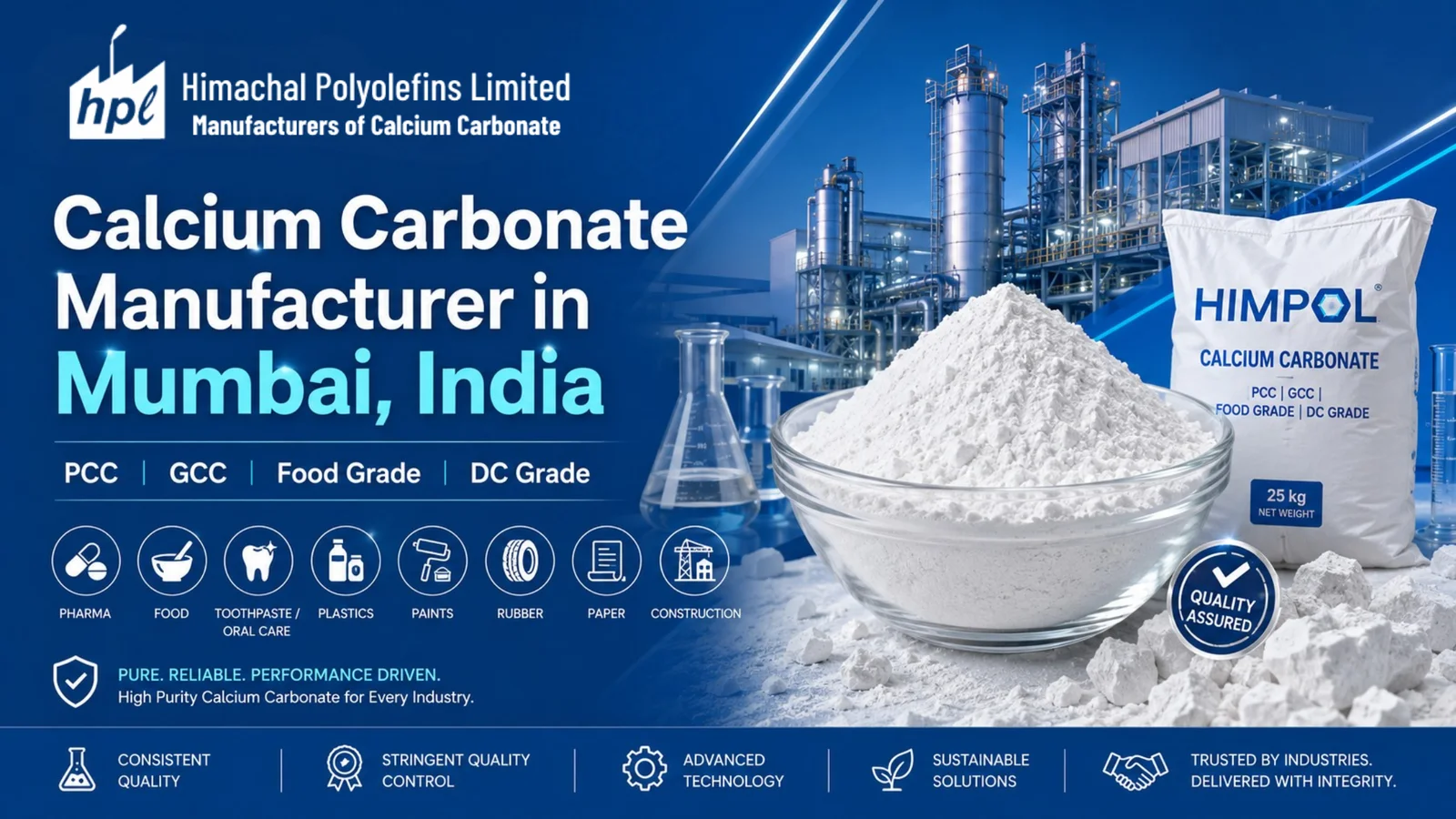
Choosing a calcium carbonate manufacturer in Mumbai, India requires more than comparing prices. The correct supplier should provide an application-appropriate grade, agreed technical specifications, current quality documents, representative samples and reliable bulk supply. Buyers should evaluate the complete cost and risk of using the material, not simply its price per kilogram.
Calcium carbonate may look like a straightforward white powder, but small differences can affect how it behaves in a formulation. Purity, particle-size distribution, moisture, bulk density, whiteness, oil absorption, surface treatment and contaminant limits can influence processing and final-product performance.
That is why a toothpaste manufacturer, tablet producer, plastic compounder and paint company should not automatically buy the same calcium carbonate grade.
Himachal Polyolefins Limited, known as HIMPOL, manufactures Precipitated Calcium Carbonate in Mumbai | India, Ground Calcium Carbonate, Direct-Compressible Calcium Carbonate and food-grade calcium carbonate for multiple industries. Its website identifies its manufacturing facility in Kala Amb, Himachal Pradesh and a branch presence in Mumbai, allowing it to serve buyers in Mumbai, Maharashtra and other Indian markets.
This guide explains how to compare manufacturers, select the right grade, verify documents, test samples and prepare a complete request for quotation.
What is calcium carbonate?
Calcium carbonate is an inorganic calcium salt with the formula CaCO₃. It occurs naturally in limestone, marble, chalk and calcite and can also be manufactured through controlled precipitation. Different production methods create grades with different particle sizes, shapes, purity levels, surface properties and application performance.
For industrial buyers, calcium carbonate is not one universal product. It is a family of materials with different specifications.
The two most widely discussed forms are:
- Ground Calcium Carbonate (GCC)
- Precipitated Calcium Carbonate (PCC)
Specialised versions may include:
- Coated GCC
- Uncoated GCC
- Fine or micronised calcium carbonate
- Food-grade calcium carbonate
- Pharmacopoeial grades
- Direct-compressible calcium carbonate
- Application-specific blends or granules
Why calcium carbonate grade matters
The wrong grade may cause:
- Poor dispersion
- Excessive formulation viscosity
- Surface defects
- Unacceptable tablet flow
- Inconsistent compression
- Changes in colour or opacity
- Sedimentation
- Abrasiveness concerns
- Regulatory rejection
- Batch-to-batch variation
Expert note: Begin with the required function of the material, not with the supplier’s standard product list.
What is the difference between PCC and GCC?
PCC is produced through a controlled precipitation process that allows the manufacturer to influence particle characteristics. GCC is produced by grinding naturally occurring calcium-carbonate-bearing minerals. GCC is commonly selected for cost-effective industrial filling, while PCC is selected when controlled morphology, purity or specialised performance is important.
| Factor | Precipitated Calcium Carbonate | Ground Calcium Carbonate |
| Common abbreviation | PCC | GCC |
| Production | Controlled precipitation | Mechanical grinding |
| Particle characteristics | Can be engineered more precisely | Influenced by mineral source and grinding |
| Typical positioning | Specialised and regulated applications | High-volume industrial applications |
| Surface treatment | Available for selected applications | Commonly available coated or uncoated |
| Cost | Often higher | Often more economical |
| Selection basis | Purity, morphology, function and compliance | Mesh, particle distribution, brightness, coating and cost |
When should a buyer consider PCC?
Consider PCC calcium carbonate when the application requires:
- Controlled particle properties
- High purity
- Consistent morphology
- Oral-care performance
- Pharmaceutical or food suitability
- Specialised paper, paint, plastic or adhesive properties
When should a buyer consider GCC?
Consider Ground Calcium Carbonate when the application requires:
- Cost-effective mineral filling
- Controlled mesh or micron size
- Brightness and whiteness
- Bulk industrial supply
- Coated material for polymer compatibility
- Uncoated material for paints, paper, adhesives or construction
Common mistake
Do not select PCC simply because it sounds more refined, and do not select GCC only because it is economical. The best grade is the grade that performs correctly in the complete formulation and meets the required specification.
Which calcium carbonate grade is suitable for each industry?
The correct grade depends on the product’s function, processing method and regulatory category. Food, pharmaceutical and oral-care companies normally require tighter controls and documentation, while plastics, paints, paper, rubber and construction buyers may focus more heavily on dispersion, particle size, coating, whiteness and cost efficiency.
| Industry | Common requirement | Important buying parameters |
| Pharmaceuticals | Calcium source, excipient or direct compression | Assay, heavy metals, microbiology, flow, density and pharmacopoeial compliance |
| Nutraceuticals | Mineral supplementation and tablets | Elemental calcium, flow, compression and documentation |
| Food and beverages | Fortification or permitted technical function | Food-grade status, purity, contaminants, microbiology and FSSAI suitability |
| Toothpaste and oral care | Mild abrasive, texture and polishing | Particle size, abrasivity, purity, whiteness and microbiology |
| Plastics and masterbatch | Filler and processing support | Coating, moisture, dispersion, D50, whiteness and loading |
| Paints and coatings | Extender and formulation control | Oil absorption, brightness, particle size, opacity and viscosity |
| Rubber | Filler and processing support | Particle size, moisture, dispersion and reinforcement behaviour |
| Paper | Filler or coating mineral | Brightness, particle distribution, opacity and dispersion |
| Construction materials | Bulk mineral filler | Mesh, moisture, consistency and delivered cost |
| Cosmetics | Absorbency, texture or opacity | Purity, particle feel, contaminants and microbiology |
| Animal nutrition | Calcium source | Calcium assay, contaminants, particle size and applicable feed requirements |
How should pharmaceutical and nutraceutical companies select calcium carbonate?
Pharmaceutical and nutraceutical buyers should begin with the finished dosage form and applicable specification. Powder intended for wet granulation may require different flow properties from material used in direct compression. Buyers should verify assay, impurity limits, density, flow, particle distribution, microbiology and relevant pharmacopoeial documentation.
Questions for pharmaceutical procurement teams
- Is the material intended as an active calcium source or excipient?
- Is it used in tablets, capsules, powders or suspensions?
- Will the process use wet granulation or direct compression?
- Which pharmacopoeial specification applies?
- What elemental calcium content is required?
- What are the lead, arsenic and other contaminant limits?
- Is microbial testing required?
- Is supplier change notification mandatory?
- Does the supplier maintain retention samples?
- Can the manufacturer provide batch traceability?
Direct-compression applications
Direct-compressible calcium carbonate is designed to improve handling and compression compared with untreated fine powder. The buyer should not evaluate only calcium assay. Flow, compressibility, granule distribution, bulk density, tapped density and tablet performance must also be tested.
Sample trial checklist
Test the sample for:
- Flow through the hopper
- Segregation
- Blend uniformity
- Tablet weight variation
- Compression force
- Hardness
- Friability
- Disintegration
- Appearance
- Assay uniformity
Warning: A supplier’s generic “pharma grade” description does not replace your approved raw-material specification.
How should food and beverage manufacturers select calcium carbonate?
Food manufacturers should use calcium carbonate that is suitable for the intended food category and complies with applicable regulations. The purchasing team should verify food-grade quality, identity, purity, contaminant limits, microbiology, traceability and whether the proposed use and level are permitted in the finished product.
FSSAI regulations identify calcium carbonate as INS 170(i) in permitted contexts and require food additives to be of appropriate food-grade quality and handled under Good Manufacturing Practice. Permission and limits depend on the food category, so buyers must verify the latest rule for their specific product rather than assuming universal permission.
Food-industry checklist
- Confirm the finished-food category
- Confirm permitted function
- Confirm maximum use level or GMP basis
- Verify FSSAI licence information
- Review food-safety certification scope
- Check contaminant limits
- Review microbiological results
- Confirm allergen and cross-contact information
- Confirm packaging suitability
- Obtain a batch-specific COA
- Maintain supplier approval records
Important distinction
A manufacturer may hold a food-safety certification, but the buyer must still confirm that:
- The exact manufacturing site is covered
- The certificate is current
- The product is within scope
- The grade meets the buyer’s specification
- The intended use is permitted
How should toothpaste and oral-care manufacturers select calcium carbonate?
Toothpaste manufacturers should evaluate calcium carbonate as a functional oral-care raw material rather than a basic filler. Particle size, shape, purity, abrasivity, whiteness, moisture, microbial quality and interaction with the toothpaste base can influence cleaning, texture, stability, appearance and consumer experience.
Parameters to discuss with the supplier
- Particle-size distribution
- Abrasivity-related performance
- Whiteness
- Moisture
- pH
- Bulk density
- Heavy metals
- Microbiological quality
- Compatibility with humectants and binders
- Batch consistency
Trial observations
During a toothpaste trial, check:
- Smoothness
- Grittiness
- Dispersion
- Viscosity
- Tube filling
- Phase separation
- Cleaning performance
- Storage stability
- Colour
- Consumer mouthfeel
HIMPOL identifies oral care as a major application and offers PCC products including HIMCAL-L and TC-202. Product selection should still be based on the buyer’s approved specification and trial results.
How should plastic and masterbatch manufacturers select calcium carbonate?
Plastic and masterbatch manufacturers should match calcium carbonate to the polymer, processing method, loading level and required mechanical properties. Coating, moisture, particle distribution, dispersion, whiteness and oil absorption can affect feeding, mixing, surface finish, output, dimensional stability and final-product performance.
Coated versus uncoated calcium carbonate
Coated calcium carbonate is surface-treated to improve compatibility with selected polymer systems. It may support better dispersion and processing in suitable applications.
Uncoated calcium carbonate may be preferred in applications where surface treatment is unnecessary or incompatible with the formulation.
Trial checklist for plastics
- Feeding behaviour
- Dispersion
- Screw torque
- Output rate
- Melt flow
- Surface defects
- Impact properties
- Tensile properties
- Dimensional stability
- Colour consistency
- Moisture-related defects
- Filter pressure where relevant
Common purchasing mistake
Do not compare two suppliers only by “mesh.” Two powders described by the same mesh may have different particle distributions, coating levels, moisture and dispersion behaviour.
How should paint and coating manufacturers select calcium carbonate?
Paint manufacturers should evaluate calcium carbonate based on the coating system and desired balance between cost, opacity, rheology, brightness, gloss and durability. Particle-size distribution, oil absorption, whiteness, moisture and dispersion can affect viscosity, pigment loading, application behaviour and the final surface.
Paint-industry questions
- Is the system water-based or solvent-based?
- Is calcium carbonate acting as an extender?
- What gloss level is required?
- What oil absorption range is acceptable?
- What particle size supports the target finish?
- Will the grade affect viscosity?
- Is sedimentation control required?
- What whiteness and brightness are needed?
- Does the material contain coarse particles?
Sample comparison
Prepare identical laboratory batches using:
- Equal formulation
- Equal mixing time
- Equal dispersion equipment
- Equal temperature
- Equal application thickness
Then compare viscosity, opacity, gloss, drying, settlement and surface finish.
How should rubber, paper and construction companies select calcium carbonate?

Rubber, paper and construction buyers often purchase calcium carbonate at high volumes, making consistency and delivered cost especially important. However, the cheapest material may increase processing problems, scrap or additive use. Buyers should compare particle distribution, moisture, dispersion, brightness, chemical consistency, packaging and freight.
Rubber
Focus on:
- Dispersion
- Particle size
- Moisture
- Compound viscosity
- Mechanical properties
- Surface finish
- Cure behaviour where relevant
Paper
Focus on:
- Brightness
- Opacity
- Particle distribution
- Dispersion
- Coating behaviour
- Printability
- Abrasion on equipment
Construction materials
Focus on:
- Mesh or particle-size range
- Moisture
- Consistent colour
- Mixing behaviour
- Workability
- Packaging integrity
- Delivered price
- Availability during peak demand
What quality parameters should buyers verify?
A professional calcium carbonate specification should include parameters that directly affect safety, processing and finished-product performance. The exact list differs by application, but buyers commonly evaluate assay, particle-size distribution, moisture, bulk density, whiteness, pH, oil absorption, impurities and microbiological quality.
12-point quality checklist
1. Assay or calcium carbonate purity
Verify:
- Specification range
- Test method
- Batch result
- Basis of calculation
- Whether the result is reported on a dry basis
2. Particle-size distribution
Ask for:
- D10
- D50
- D90
- Sieve or mesh data
- Test equipment and method
D50 means that half of the measured particle population is smaller than the stated size under the selected analytical method. It does not describe the complete distribution.
3. Moisture
Excess moisture may contribute to:
- Lumping
- Feeding difficulties
- Poor flow
- Storage problems
- Polymer processing defects
- Inaccurate weight-based formulation
4. Bulk density
Bulk density affects:
- Bag volume
- Hopper capacity
- Flow
- Freight efficiency
- Tablet formulation
- Dosing equipment
5. Tapped density
Tapped density is particularly relevant where packing behaviour, compression or volumetric dosing matters.
6. Whiteness and brightness
These are important in:
- Toothpaste
- Paper
- Paint
- Plastic
- Cosmetics
- White rubber products
Ask which measurement scale and method are used.
7. Oil absorption
Oil absorption can influence binder demand, viscosity and formulation economics in paints, coatings and related systems.
8. pH
pH may affect formulation compatibility. Confirm the slurry concentration and test method because results cannot be compared reliably without the same method.
9. Heavy metals and contaminants
Regulated and sensitive applications may require limits for:
- Lead
- Arsenic
- Mercury
- Cadmium
- Iron
- Magnesium
- Silica
- Acid-insoluble matter
10. Microbiological quality
Food, pharma, nutraceutical and personal-care applications may require:
- Total plate count
- Yeast and mould
- Specified pathogen testing
- Hygiene controls
11. Surface coating
For coated grades, verify:
- Coating material
- Coating percentage
- Uniformity
- Moisture
- Compatibility
- Method of confirmation
12. Coarse-particle control
A small number of coarse particles can cause:
- Grittiness
- Surface defects
- Screen blockage
- Abrasion
- Poor oral-care feel
Which documents should a manufacturer provide?
A dependable manufacturer should provide documents that allow the buyer to understand the product, verify each batch, handle the material safely and assess regulatory suitability. At minimum, buyers usually request a Technical Data Sheet, Safety Data Sheet and batch-specific Certificate of Analysis.
| Document | Purpose |
| COA | Reports actual results for a specific batch |
| TDS | Describes standard product characteristics |
| SDS | Provides safety, handling and storage information |
| Product specification | Defines agreed acceptance limits |
| Certificate copies | Supports management-system or regulatory claims |
| Declaration documents | Address allergens, GMO, origin or other buyer requirements |
| Change-control policy | Explains how changes will be communicated |
| Traceability statement | Explains batch identification and records |
| Sample COA | Helps buyers evaluate reporting quality before ordering |
Certificate of Analysis
A useful COA should include:
- Manufacturer name
- Product name
- Grade
- Batch number
- Manufacturing date
- Retest or expiry information where applicable
- Specification limits
- Actual test results
- Test methods or references
- Approval signature or authorised release
- Document date
Technical Data Sheet
The TDS should explain:
- Product description
- Typical properties
- Intended applications
- Physical characteristics
- Packaging
- Storage
- Shelf-life guidance
- Regulatory positioning
Safety Data Sheet
The SDS should include:
- Identification
- Hazard information
- Handling precautions
- Exposure controls
- Physical properties
- Stability
- Transport information
- Disposal information
Warning: A TDS normally contains typical values. It should not be treated as a batch-specific COA.
How can buyers verify manufacturer certifications?
Buyers should not rely only on logos displayed on a website. Ask for the current certificate, verify the legal company name, manufacturing address, certificate number, standard, issue date, expiry date, certification body and scope. Confirm that the product and facility relevant to your order are included.
ISO explains that certification is written assurance from an independent body that a product, service or system meets defined requirements. ISO itself develops standards but does not issue company certificates.
Certificate-verification checklist
- Is the company name correct?
- Is the manufacturing-site address correct?
- Is the certificate currently valid?
- Is the standard version correct?
- Is the certification body identified?
- Is the certification body accredited?
- Does the scope cover calcium carbonate manufacturing?
- Does the food-safety scope cover the relevant product?
- Are old certificate logos still being displayed?
- Can the certificate be independently verified?
HIMPOL certification wording
HIMPOL’s website currently lists ISO, FSSC, FSSAI, IP/BP/USP-related licences, GMP, Halal and Kosher credentials. Buyers should request current copies and confirm the precise scope before using any claim in their own regulatory documentation.
How should buyers evaluate a calcium carbonate sample?
A sample should be representative of normal commercial production and evaluated against an agreed specification and finished-product trial. Laboratory results alone are not sufficient. The material must also perform correctly in the buyer’s real formulation, process equipment and storage conditions.
Step-by-step sample approval process
Step 1: Define the requirement
Share:
- Application
- Existing grade
- Target specification
- Processing method
- Annual consumption
- Current problems
- Regulatory requirements
Step 2: Request supporting documents
Obtain:
- TDS
- SDS
- Sample COA
- Certificate copies
- Packaging details
- Storage guidance
Step 3: Test the sample independently
Compare supplier results with internal or third-party laboratory results.
Step 4: Conduct a small formulation trial
Use controlled conditions and document every variable.
Step 5: Conduct a production-scale trial
A laboratory success may not predict full-scale feeding, mixing or compression.
Step 6: Define the approved specification
Agree on:
- Parameter
- Test method
- Minimum or maximum limit
- Reporting format
- Change-notification process
Step 7: Compare the first commercial batch
Test it against:
- Approved sample
- Agreed specification
- Trial performance
- Supplier COA
Step 8: Monitor repeat batches
Track trends rather than reviewing each result in isolation.
What is the difference between a manufacturer and a trader?
A manufacturer controls production and can usually provide deeper information about raw materials, processing, testing, change control and customisation. A trader may provide fast sourcing and multiple brands but may have less control over production. Buyers should verify the actual role of every supplier.
| Factor | Manufacturer | Trader or distributor |
| Production control | Direct | Indirect |
| Custom grades | More likely | Depends on principal |
| Root-cause investigation | Direct access | May require coordination |
| Factory audit | Usually possible | Not applicable to trader’s office |
| Multiple brands | Usually limited | Often available |
| Stock availability | Depends on production | May maintain local inventory |
| Technical depth | Usually product-specific | Varies |
| Traceability | Direct batch records | Depends on supply chain |
A trader is not automatically unsuitable. The key is transparency. The buyer should know:
- Who manufactured the material
- Which facility produced it
- Who releases the batch
- Who handles complaints
- Whether the grade can change without notice
What affects calcium carbonate price?
Calcium carbonate price depends on much more than purity. Production method, particle size, coating, testing, regulatory grade, packaging, order volume, freight, credit terms and customisation all affect the quotation. Buyers should compare landed and process-adjusted cost rather than only the basic price per kilogram.
Main price factors
- PCC versus GCC
- Particle-size fineness
- Narrowness of particle distribution
- Surface coating
- Purity
- Whiteness
- Heavy-metal control
- Microbiological testing
- Pharmacopoeial requirements
- Food-grade manufacturing controls
- Granulation or direct-compression properties
- Bag size
- Palletisation
- Minimum order
- Transport distance
- Payment terms
- Custom testing
- Technical support
Compare total cost
Use this simple framework:
Total effective cost = material price + freight + handling + storage + processing impact + scrap + downtime + quality risk
A low-priced powder may become expensive if it:
- Reduces production output
- Requires more binder or additive
- Causes screen blockage
- Produces rejected batches
- Leads to customer complaints
- Arrives late
- Requires frequent re-testing
What mistakes should buyers avoid?

The most common mistakes are selecting by price alone, using an unsuitable grade, accepting incomplete documentation, skipping production trials and failing to agree on test methods. These mistakes often create higher costs later through inconsistent production, quality failures, rework and supply disruption.
Mistake 1: Buying only on price
A price comparison is meaningless unless both products meet the same specification and perform similarly.
Mistake 2: Using the term “calcium carbonate” without a grade
An RFQ should identify the required type, application and specification.
Mistake 3: Comparing mesh alone
Mesh does not fully describe fine particle distribution.
Mistake 4: Accepting typical values as guaranteed limits
Typical data should not replace an agreed specification.
Mistake 5: Skipping document verification
A logo on a brochure is not proof of current certification.
Mistake 6: Skipping the production trial
Laboratory blending may not reveal feeding, mixing or scale-up problems.
Mistake 7: Ignoring packaging
Poor packaging can allow contamination, moisture entry and material loss.
Mistake 8: Failing to agree on change control
The manufacturer should notify the buyer before important changes to raw material, process, specification, test method, facility or packaging.
Mistake 9: Ignoring delivery resilience
Ask about contingency planning, inventory and peak-demand supply.
Mistake 10: Publishing unverified claims
Food, pharmaceutical, medical and certification claims should be checked by the relevant regulatory or quality team.
How should buyers compare calcium carbonate manufacturers?
Use a weighted supplier scorecard rather than relying on sales claims. Score each manufacturer on grade fit, sample performance, documentation, technical support, quality systems, supply reliability, price, communication and complaint handling. The highest-value supplier may not be the supplier with the lowest quotation.
Manufacturer scorecard
| Category | Suggested weight |
| Product and grade suitability | 20% |
| Sample and production-trial performance | 20% |
| Quality systems and documents | 15% |
| Batch consistency | 10% |
| Technical support | 10% |
| Supply capacity and delivery | 10% |
| Landed cost | 10% |
| Communication and complaint handling | 5% |
Decision rule
Do not approve a supplier when any critical safety, regulatory or application requirement fails, even if the total commercial score is high.
Why consider HIMPOL for calcium carbonate supply?
HIMPOL offers PCC, GCC, direct-compressible and food-grade calcium carbonate for regulated and industrial applications. Its broad product and industry coverage makes it suitable for buyers who prefer to discuss application-specific requirements with one manufacturer rather than source unrelated grades from several suppliers.
HIMPOL’s current product range includes:
- Precipitated Calcium Carbonate
- Ground Calcium Carbonate
- Direct-Compressible Calcium Carbonate in mumbai | india
- Food-Grade Calcium Carbonate in mumbai | india
The company states that it serves oral care, cosmetics, pharmaceuticals, nutraceuticals, food, plastics, rubber, paints, sealants, adhesives, paper, animal nutrition, construction and glass industries.
HIMPOL buyer-verification checklist
Before ordering, request:
- Product-specific TDS
- Latest SDS
- Sample COA
- Current certificates
- Grade recommendation
- Representative sample
- Packaging information
- Minimum order quantity
- Delivery estimate
- Technical trial support
- Complaint contact
- Change-control process
Transparent local positioning
HIMPOL should describe itself as a calcium carbonate manufacturer serving Mumbai and India unless it operates a calcium-carbonate manufacturing facility within Mumbai itself. This wording supports local relevance without confusing a Mumbai sales or branch presence with the actual production location
FAQ
1. Is PCC always better than GCC?
No. PCC and GCC serve different requirements. PCC may offer controlled particle properties, while GCC may provide a cost-effective solution for high-volume industrial applications.
2. Which calcium carbonate is used in toothpaste?
Toothpaste commonly uses calcium carbonate selected for suitable purity, particle size, abrasivity, whiteness and formulation compatibility. The final choice should be supported by oral-care trials.
3. Which calcium carbonate is suitable for tablets?
The suitable grade depends on whether the process uses granulation, direct compression, capsules or another dosage form. Direct-compressible calcium carbonate is designed for applications that require improved flow and compression.
4. Can calcium carbonate be used in food products?
Calcium carbonate is permitted in specified food contexts under applicable regulations. The finished-food category, technical function and use level must be checked against the current FSSAI requirements.
5. What does INS 170(i) mean?
INS 170(i) is the International Numbering System identifier used for calcium carbonate in food-additive regulations.
6. What documents should I request?
Request a product specification, TDS, SDS, sample COA, batch COA, applicable certificates, packaging details and required declarations.
7. What is the difference between a COA and TDS?
A COA provides actual results for a specific batch. A TDS usually provides product descriptions and typical technical information.
7. Should every batch have a COA?
For controlled B2B supply, a batch-specific COA is strongly recommended, especially for regulated or specification-sensitive applications.
8. What is D50?
D50 is the median particle size under a specified measurement method. Half of the measured particle population is below the stated size.
9. Is mesh size enough to compare suppliers?
No. Mesh data alone may not describe the complete fine-particle distribution. Ask for D10, D50 and D90 where relevant.
10. Why is moisture important?
Moisture can affect flow, storage, feeding, dispersion, compression and polymer processing. The acceptable limit depends on the application