Rubber manufacturers face a difficult balancing act. They must control production costs while maintaining hardness, flexibility, surface finish, durability, and reliable processing. Even a small change in filler quality can affect the final compound.
Calcium carbonate is widely used in rubber formulations as a mineral filler. However, choosing it only by price can be costly. The wrong particle size, high moisture, poor dispersion, or inconsistent purity may cause uneven mixing, weak mechanical properties, surface defects, and batch-to-batch variation.
For businesses searching for calcium carbonate Manufacturers in Mumbai | India, the key is to look beyond the product name. Ground Calcium Carbonate, Precipitated Calcium Carbonate, coated grades, and uncoated grades behave differently inside a rubber compound.
This guide explains how calcium carbonate works in rubber, its main benefits, grade-selection factors, pricing, alternatives, and important industry trends for 2026. It will help rubber-product manufacturers make a more informed purchasing decision.
What Is the Best Calcium Carbonate for the Rubber Industry?

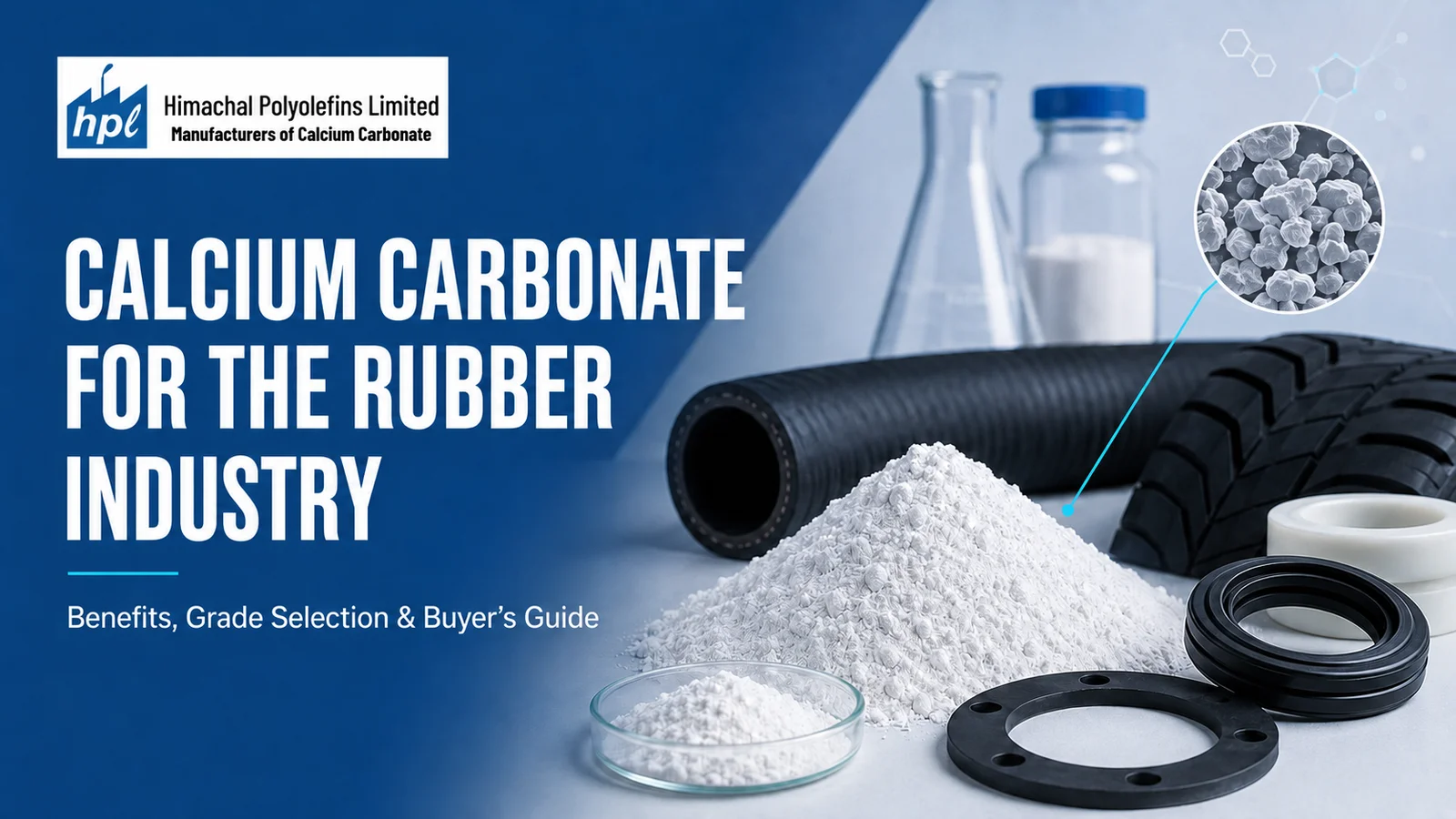
Calcium carbonate for the rubber industry is a mineral filler used to improve processing, control hardness, support dimensional stability, enhance surface appearance, and manage formulation costs. The best grade depends on the rubber polymer, product requirements, particle size, surface treatment, moisture level, purity, and required filler loading.
What Is Calcium Carbonate for the Rubber Industry?
Calcium carbonate is an inorganic mineral compound with the chemical formula CaCO₃. In rubber manufacturing, it is mixed with natural or synthetic rubber along with curing agents, process oils, pigments, stabilisers, and other additives.
It is generally available in two main forms:
- A GCC calcium carbonate manufacturer processes naturally occurring limestone or calcite through crushing, grinding, classification and, when required, surface coating.
- A PCC manufacturer in India produces calcium carbonate through a controlled precipitation process. This allows greater control over particle shape, particle size and certain performance properties.
- Coated Calcium Carbonate: Surface-treated, often to improve compatibility and dispersion in polymer-based formulations.
- Uncoated Calcium Carbonate: Used where surface treatment is unnecessary and standard filling performance is sufficient.
Calcium carbonate is often treated as a non-reinforcing or semi-reinforcing filler. Its actual effect depends heavily on particle size, particle shape, dispersion, surface chemistry, and loading level.
Research has shown that treated calcium carbonate may provide better tensile performance than untreated material in certain natural-rubber formulations. However, the result depends on the complete compound recipe rather than the filler alone. Polymers research on treated calcium carbonate
Why Is Calcium Carbonate Important in Rubber Manufacturing?
Rubber manufacturers use calcium carbonate for practical performance and commercial reasons.
- Cost control: It can reduce dependence on more expensive compound ingredients.
- Hardness adjustment: The filler loading can help formulators reach the required hardness range.
- Better dimensional stability: It may help finished components hold their intended shape.
- Processing support: A suitable grade can contribute to smoother mixing, extrusion, and moulding.
- Improved appearance: High-whiteness grades are useful for light-coloured and coloured rubber goods.
- Surface finish: Fine, well-dispersed particles may produce a smoother finished surface.
- Compound consistency: A stable particle-size distribution supports more predictable production.
- Controlled density: Calcium carbonate affects the weight and density of a rubber compound.
- High filler-loading potential: It can be used at practical loading levels when the formulation and dispersion system permit.
India also has a dedicated Bureau of Indian Standards specification for activated calcium carbonate used in the rubber industry, showing the material’s established industrial importance. BIS specification for activated calcium carbonate
Quick Summary: Calcium carbonate does more than lower formulation costs. When the correct grade is selected, it can support hardness, appearance, processing, dimensional stability, and production consistency.
How Does Calcium Carbonate Work in a Rubber Compound?
Calcium carbonate is not simply poured into rubber without planning. Its performance depends on careful grade selection and controlled mixing.
Step 1: Define the finished rubber product
First, identify what you are manufacturing. A footwear sole, rubber mat, hose, gasket, cable compound, seal, or moulded component may require a different balance of flexibility, strength, hardness, and finish.
Step 2: Identify the rubber polymer
The formulation may use natural rubber, SBR, EPDM, NBR, neoprene, or another elastomer. Filler compatibility and processing behaviour can change from one polymer system to another.
Step 3: Set the required properties
Define measurable targets such as:
- Shore hardness
- Tensile strength
- Elongation
- Tear resistance
- Abrasion resistance
- Density
- Colour
- Surface finish
- Compression behaviour
- Weather or chemical resistance
Step 4: Select PCC or GCC
GCC may be suitable for economical, general-purpose filling. PCC offers more controlled particle characteristics and may be considered where finer particles, appearance, or more precise performance is required.
This is not a universal rule. Lab trials should confirm which material works best in the actual formulation.
Step 5: Decide between coated and uncoated material
Coated calcium carbonate can improve the interaction between the mineral surface and the rubber matrix. It may also support dispersion and reduce particle agglomeration in suitable compounds.
Uncoated grades may be appropriate for simpler formulations where standard filling performance is the main goal.
Step 6: Check technical specifications
Before approving a grade, review:
- Calcium carbonate assay
- Particle-size distribution
- Moisture content
- Whiteness or brightness
- Bulk density
- Surface coating
- Oil absorption
- pH value
- Residue on sieve
- Certificate of Analysis
Step 7: Run a production trial
A sample may look excellent on paper but behave differently in a working compound. Test the material at multiple loading levels and examine mixing time, dispersion, curing behaviour, finish, and mechanical properties.
Step 8: Approve the commercial batch
Once trial results meet the target, establish an approved specification. Future supplies should be checked against this benchmark to reduce unexpected changes.
What Are the Benefits of Calcium Carbonate in Rubber?
The right grade can offer several useful advantages:
- Helps lower the overall compound cost
- Supports targeted hardness and stiffness
- Improves dimensional control in selected applications
- Can provide a smoother and more uniform surface
- Supports bright or coloured rubber formulations
- May improve processing when properly dispersed
- Allows formulators to adjust product density
- Offers practical filling capacity
- Is widely available for industrial use
- Can reduce performance variation when quality remains consistent
Particle treatment matters. Published research has found that surface modification can improve filler–rubber interaction and mechanical properties in particular formulations. Other studies also show that particle aggregation and larger, poorly dispersed particles may create processing and appearance problems. Study on calcium carbonate surface treatment
How Does Calcium Carbonate Compare with Alternative Rubber Fillers?
| Filler | Main role | Key advantages | Possible limitations | Common suitability |
|---|---|---|---|---|
| Calcium carbonate | Functional and economical filler | Cost-effective, white, widely available, adjustable loading | Usually offers less reinforcement than carbon black or silica | Footwear, mats, profiles, sheets, hoses and moulded goods |
| Carbon black | Reinforcing filler and pigment | Strong reinforcement, abrasion resistance, UV protection | Black colour limits light-coloured applications | Tyres, belts, heavy-duty rubber and black technical products |
| Silica | Reinforcing or functional filler | Supports strength and specialised performance | Higher cost and more demanding dispersion | Tyres, footwear and high-performance compounds |
| Clay | General-purpose or semi-reinforcing filler | Economical and useful for hardness control | May affect colour, finish, or mechanical performance | General moulded and extruded rubber goods |
| Talc | Plate-like functional filler | Supports stiffness, dimensional stability, and heat-related performance | May reduce flexibility at high loading | Specialised moulded parts and selected technical compounds |
Calcium carbonate is not always a direct replacement for carbon black or silica. A formulator may use two or more fillers together to achieve the right mix of cost, processing, colour, and mechanical performance.
Who Needs Rubber-Grade Calcium Carbonate?
Rubber-grade calcium carbonate may be useful for manufacturers producing:
- Footwear soles and components
- Rubber mats and floor coverings
- Automotive rubber parts
- Hoses and flexible profiles
- Gaskets, seals, and washers
- Cable-insulation compounds
- Rubber sheets
- Conveyor-related components
- Moulded household rubber goods
- Coloured and light-coloured rubber products
- General-purpose industrial rubber parts
Imagine a manufacturer producing white rubber seals. A low-whiteness or poorly dispersed filler may create grey patches and an uneven surface. The component may still function, but would a customer accept that appearance?
That is why purchasing teams, compound developers, quality-control teams, and production managers should evaluate the grade together.
What Determines the Price of Calcium Carbonate for Rubber?
There is no single fixed price for every rubber-grade calcium carbonate product. The commercial rate depends on the material specification and supply conditions.
Important pricing factors include:
- PCC or GCC grade
- Coated or uncoated surface
- Purity and chemical composition
- Particle-size range
- Whiteness requirement
- Moisture specification
- Processing and quality-control requirements
- Packaging type
- Order quantity
- Transport distance
- Delivery schedule
- Custom specification or documentation needs
A cheaper material does not always lower the final production cost. If it creates lumps, increases rejection, slows mixing, or causes inconsistent hardness, the apparent saving may disappear quickly.
Buyers comparing Manufacturers calcium carbonate in Mumbai | India should calculate cost per acceptable finished batch—not merely cost per kilogram of powder.
What Are the Calcium Carbonate Trends in the Rubber Industry in 2026?
In 2026, rubber manufacturers are paying closer attention to process efficiency, traceability, material consistency, and responsible resource use.
Finer and better-controlled particles
Manufacturers increasingly want controlled particle-size distribution rather than a broad, inconsistent powder range. Fine particles can offer a greater surface area, although they must be dispersed correctly to avoid agglomeration.
Greater demand for surface-treated grades
Coated and modified calcium carbonate grades are receiving attention because surface treatment can improve compatibility with polymer systems and support better dispersion.
More testing before bulk approval
Rubber companies are asking for Certificates of Analysis, technical data, samples, and compound trials before committing to regular bulk orders.
Focus on batch-to-batch consistency
Automated production lines require predictable raw materials. A change in moisture, bulk density, or particle distribution can affect dosing and mixing.
Smarter use of hybrid filler systems
Formulators are studying combinations of calcium carbonate with silica, carbon black, bio-based fillers, and recycled inputs. The goal is to balance cost, mechanical performance, and environmental priorities.
Recent research also continues to examine recovered and waste-derived calcium carbonate for composite applications. However, consistent purity and performance remain essential before such materials can be adopted commercially. 2025 research on recovered calcium carbonate in rubber composites
Why Choose Himachal Polyolefins Limited in Mumbai?
Himachal Polyolefins Limited, also searched as Himachal Polyolefins Ltd, Himachal Polyolefins and HIMPOL, supplies PCC, GCC, coated and uncoated grades, food-grade calcium carbonate and direct-compression products.Himachal Polyolefins Limited supports businesses looking for a dependable Manufacturer of Calcium Carbonate in Mumbai | India. The company offers calcium carbonate solutions for diverse industrial applications, including PCC, GCC, coated, and uncoated grades.
Rubber manufacturers can evaluate important quality factors such as:
- Purity and chemical consistency
- Particle-size distribution
- Moisture control
- Whiteness and brightness
- Packaging quality
- Batch-to-batch consistency
- Product documentation
- Application-based grade selection
- Dependable bulk supply
For buyers comparing Manufacturers calcium carbonate in Mumbai | India, technical support is as important as supply capacity. A dependable supplier should help the buyer compare specifications, review application needs, and test the selected grade before regular commercial use.
Himachal Polyolefins Limited focuses on quality-controlled processing, secure packaging, and reliable supply. This makes the company a practical choice for rubber manufacturers in Mumbai and other industrial locations across India.
FAQs About Calcium Carbonate for the Rubber Industry
1. Which calcium carbonate grade is best for rubber?
The best grade depends on the rubber polymer, finished product, required hardness, colour, particle size, and filler loading. Fine PCC or coated calcium carbonate may suit applications needing better dispersion or finish, while GCC may be suitable for economical general-purpose filling.
2. Why is coated calcium carbonate used in rubber?
Coated calcium carbonate has a surface treatment that may improve compatibility with the rubber matrix. In a suitable formulation, this can support dispersion, processing, surface quality, and filler–polymer interaction.
3. Does calcium carbonate increase rubber hardness?
Yes, calcium carbonate can influence compound hardness and stiffness. The final result depends on its particle size, loading level, surface treatment, rubber polymer, process oil, and the rest of the formulation.
4. Can calcium carbonate replace carbon black in rubber?
Not in every application. Carbon black provides stronger reinforcement, abrasion resistance, black pigmentation, and UV protection. Calcium carbonate is generally chosen for cost control, light-coloured products, processing, and general filling. Some compounds use both.
5. How should buyers select manufacturers of calcium carbonate in Mumbai, India?
Buyers should compare purity, particle-size distribution, moisture, whiteness, coating, batch consistency, packaging, technical documents, and supply reliability. They should also conduct a production trial before approving a grade for bulk use.
Talk to a Reliable Calcium Carbonate Manufacturer
The right filler can make production more predictable, improve product appearance, and support better cost control. The wrong one may lead to poor dispersion, rejected batches, and avoidable production delays.
If you are searching for Manufacturers calcium carbonate in Mumbai | India, connect with Himachal Polyolefins Limited | Manufacturer of Calcium Carbonate in Mumbai | India.
Share your rubber application, required specifications, expected quantity, and performance targets to identify a suitable calcium carbonate grade for testing and bulk supply.