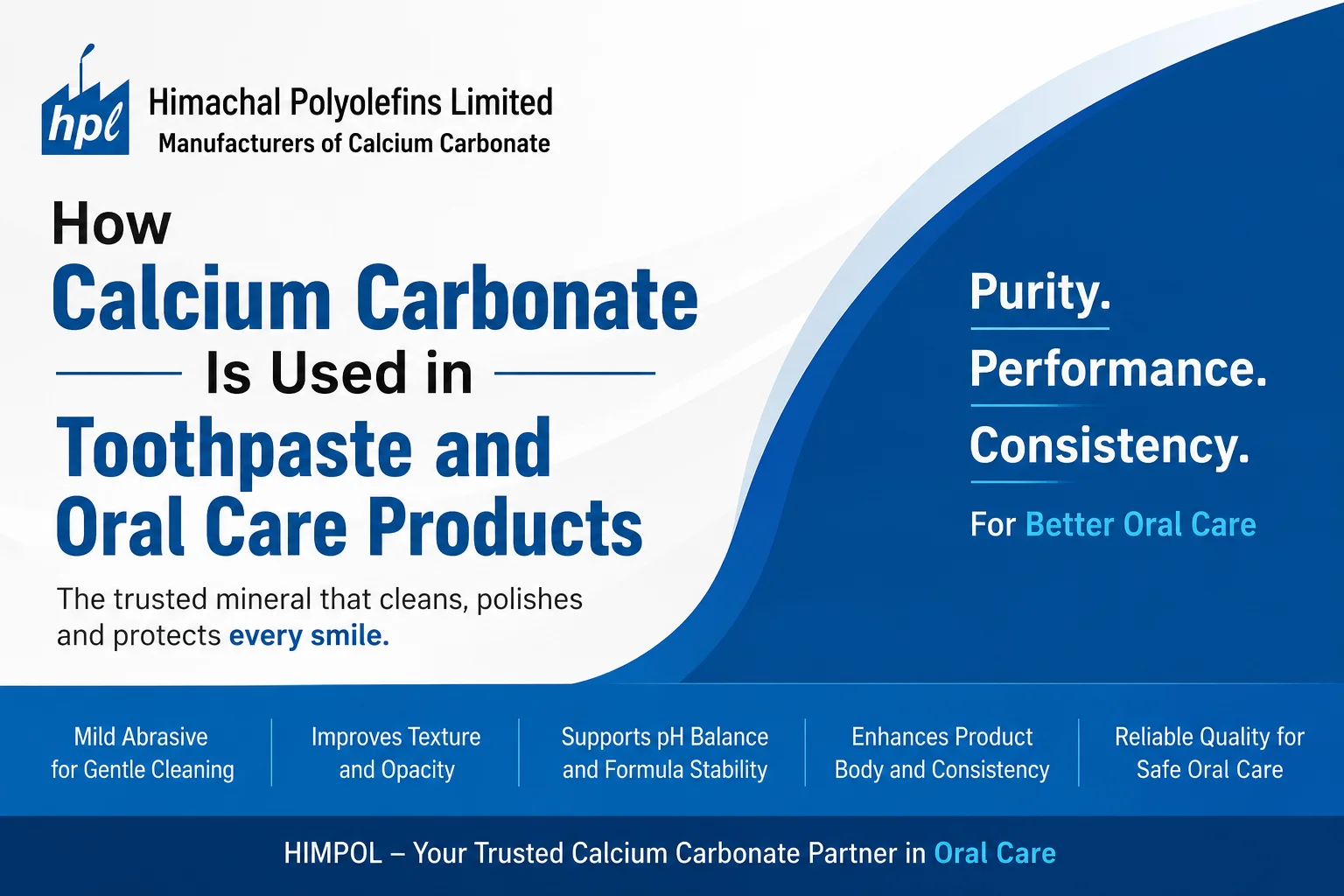
Calcium Carbonate Manufacturer Mumbai suppliers support toothpaste and oral care brands with carefully processed mineral grades. Calcium carbonate works mainly as a mild abrasive that helps remove plaque, food particles and surface stains while also improving toothpaste texture, opacity and consistency.
However, selecting calcium carbonate for toothpaste is not only about choosing a white powder. Oral care manufacturers must consider purity, particle size, moisture, texture and compatibility with the complete formulation. A coarse or inconsistent grade may make the toothpaste feel gritty or affect product stability.
Himachal Polyolefins Limited supplies calcium carbonate for toothpaste and oral care applications from Vile Parle West, Mumbai. The right grade can support gentle cleaning, smooth texture, opacity and consistent product performance.
Brands searching for manufacturers calcium carbonate in Mumbai | India need more than a low price. They need an application-suitable grade with reliable specifications and consistent supply. In toothpaste, calcium carbonate acts mainly as a mild abrasive that helps remove plaque, food debris and surface stains. It can also support opacity, body and texture.
The American Dental Association lists calcium carbonate as a toothpaste abrasive. The European Commission identifies its cosmetic functions as abrasive, buffering, bulking, opacifying and oral care.
How Is Calcium Carbonate Used in Toothpaste?
use of calcium carbonate in dental product mainly as a mild abrasive. It helps remove plaque, food particles and surface stains while brushing. It may also improve toothpaste body, opacity, texture and pH balance. Its effectiveness depends on purity, particle size, shape and compatibility with the complete oral care formulation.
What Is Calcium Carbonate in Toothpaste and Oral Care Products?

Calcium carbonate is a mineral with the formula CaCO₃. In oral care products, a carefully processed grade is used as a functional ingredient rather than as ordinary industrial powder.
Although calcium carbonate powder uses in Mumbai | India and calcium carbonate industrial uses in Mumbai | India cover many sectors, oral care requires a carefully selected grade.
Precipitated calcium carbonate, or PCC, is produced under controlled conditions to manage particle size, shape, whiteness and bulk density. These properties matter because toothpaste must clean without feeling gritty.
So, what is the use of calcium carbonate in toothpaste? As the toothbrush moves over the teeth, its particles help loosen deposits and polish away external stains.
A clinical study of a calcium carbonate and perlite whitening toothpaste found effective removal of extrinsic stains without greater enamel or dentine abrasivity than the comparison whitening toothpastes tested.
Why Is Calcium Carbonate Important in Toothpaste and Oral Care Products?
The World Health Organization estimates that oral diseases affect nearly 3.7 billion people worldwide. Safe and affordable daily oral care products therefore remain important for preventive health.
Calcium carbonate supports toothpaste by providing:
- Plaque and debris removal: It creates gentle friction during brushing.
- Surface stain removal: It helps polish stains caused by tea, coffee and food.
- Smooth product body: Controlled particles support a consistent paste texture.
- White appearance: Its whiteness creates an opaque and clean-looking formula.
- Bulking support: It adds body and solid content.
- Buffering action: It can help resist sudden pH changes.
- Cost efficiency: One mineral can perform several useful functions.
The goal is balance. More abrasiveness does not always mean better cleaning.
How Does Calcium Carbonate Work in Toothpaste? A Step-by-Step Process
Step 1: Select the Correct Grade
The formulator checks purity, particle size distribution, moisture, whiteness, bulk density and microbiological requirements.
Precipitated calcium carbonate in India may be selected when controlled particle properties are needed. The chosen grade should match the desired cleaning performance, mouthfeel and manufacturing process.
Step 2: Check Ingredient Compatibility
Toothpaste may contain humectants, binders, surfactants, flavours, sweeteners and fluoride. Each ingredient must work properly with the calcium carbonate grade.
Calcium-based abrasives can affect some fluoride salts. Research shows that sodium monofluorophosphate is generally more compatible with calcium-containing abrasives than freely ionic fluoride sources. Shelf-life testing is still essential.
Step 3: Disperse the Powder
Calcium carbonate is mixed into the gel base. Good dispersion helps prevent lumps and uneven texture.
Imagine squeezing toothpaste onto a brush and noticing rough particles or separated liquid. Even if the ingredients are technically correct, poor dispersion can create an unpleasant user experience.
Step 4: Adjust Texture and Cleaning
The product-development team checks viscosity, spreadability, mouthfeel and cleaning action.
Particle size and shape strongly influence whether the toothpaste feels smooth or gritty. This is why controlled PCC may be preferred for formulations requiring specific physical properties.
Step 5: Validate the Finished Product
The toothpaste is tested for:
- Product stability
- Available fluoride where applicable
- Abrasivity
- Microbial quality
- Cleaning performance
- Packaging compatibility
- Colour and texture consistency
Raw-material approval alone is not enough. The complete toothpaste formulation must be evaluated under realistic storage and usage conditions.
Calcium carbonate works through controlled polishing action. Good results depend on the right grade, even dispersion, suitable fluoride chemistry and testing of the complete formula.
What Are the Benefits of Calcium Carbonate in Toothpaste?
The main precipitated calcium carbonate uses in oral care include:
- Mechanical cleaning during brushing
- Removal of common external stains
- Smooth polishing with controlled particles
- Improved whiteness and opacity
- Better toothpaste body and consistency
- Support for economical formulations
- Use in standard, herbal and selected whitening products
- Reliable processing with consistent specifications
These benefits keep calcium carbonate in toothpaste in Mumbai | India relevant across several product segments.Reliable Calcium Carbonate Manufacturers in Mumbai | India help oral care brands maintain consistent texture, cleaning performance and product appearance.
It can support affordable everyday toothpaste as well as specialised products where smooth texture, appearance and controlled cleaning are important.
Calcium Carbonate vs Other Toothpaste Abrasives
| Abrasive | Main Strengths | Points to Consider |
|---|---|---|
| Calcium carbonate | Cleaning, opacity, body and cost efficiency | Requires particle and fluoride compatibility control |
| Hydrated silica | Flexible abrasivity and broad formulation use | Cost depends on grade and performance |
| Dicalcium phosphate | Cleaning and polishing | Texture and compatibility need testing |
| Sodium bicarbonate | Cleaning and buffering | Taste may affect consumer acceptance |
| Alumina-based abrasives | Strong polishing | Abrasivity must be controlled |
There is no single best abrasive for every toothpaste.
The right option depends on the product claim, fluoride system, desired mouthfeel, price point and manufacturing process. A children’s toothpaste may require a different cleaning profile from a whitening product designed for tea or coffee stains.
Who Needs Oral Care Grade Calcium Carbonate?
Application-suitable calcium carbonate may be required by:
- Toothpaste and dentifrice manufacturers
- Herbal oral care brands
- Private-label and contract manufacturers
- Tooth powder manufacturers
- Personal care formulators
- Product-development laboratories
- Exporters sourcing oral care ingredients from India
A company looking for a Calcium Carbonate manufacturer in Mumbai should share its target particle size, formulation type, fluoride system and expected production volume.
This information helps the supplier understand the application instead of recommending a general-purpose grade.
What Determines the Cost of Calcium Carbonate for Toothpaste?
Pricing depends on several technical and commercial factors:
- Purity and contaminant limits
- Particle size distribution
- PCC processing controls
- Whiteness requirements
- Moisture limits
- Testing and documentation
- Packaging format
- Order volume
- Freight and delivery location
- Product customisation needs
Calcium Carbonate production in Mumbai and calcium carbonate production in India may involve different plant locations, processing capabilities and logistics arrangements.
Buyers in Mumbai should compare delivered value instead of only the lowest rate. Consistent material may reduce rejected batches and production delays.
A lower-priced powder can become expensive when it causes texture variation, failed stability tests or manufacturing interruptions.
What Are the Oral Care Industry Trends in 2026?
The global oral care market is projected to grow from USD 42.3 billion in 2026 to USD 66.4 billion by 2033.
Important 2026 trends include:
- Low-abrasion whitening: Consumers want stain removal without a harsh feel.
- Multifunctional toothpaste: Products combine cleaning with sensitivity, gum care or freshness claims.
- Particle engineering: Manufacturers are paying more attention to size, shape and surface behaviour.
- Stronger documentation: Buyers expect clear COA, TDS and SDS support with traceability.
- Advanced calcium materials: Research into nano-calcium carbonate and calcium-based remineralisation continues although safety and performance must be carefully evaluated.
- Value with quality: Brands need stable and affordable formulations for large consumer markets.
For a precipitated calcium carbonate manufacturer in India, these shifts make consistency and technical support more important than commodity-only supply.
Oral care brands are no longer looking only for a powder that meets a basic description. They increasingly want materials that support repeatable performance, regulatory documentation and faster product development.
Why Choose Himachal Polyolefins Limited in Mumbai?
Himachal Polyolefins Limited supplies calcium carbonate for toothpaste, oral care, pharmaceuticals, food and nutrition.
Its portfolio includes:
- Precipitated Calcium Carbonate
- Ground Calcium Carbonate
- Direct Compressible Grade Calcium Carbonate
- Food-Grade Calcium Carbonate
Companies comparing calcium carbonate manufacturers in India can contact HIMPOL directly in Vile Parle West, Mumbai. Its official address is at Golden Tobacco House on Swami Vivekananda Road, Navpada.
Brands searching for Calcium Carbonate manufacturers in Mumbai | India can approach HIMPOL for:
- Application-focused product discussions
- Consistent quality parameters
- PCC options for oral care
- Technical documents and specifications
- Secure industrial packaging
- Bulk and repeat supply support
As a precipitated calcium carbonate manufacturer in India, HIMPOL understands that toothpaste performance depends on the complete formulation.
The material should always be checked against the buyer’s manufacturing process, fluoride system, quality requirements and product goals.
FAQs
1. Why Is Calcium Carbonate Added to Toothpaste?
Calcium carbonate is added mainly as a mild abrasive. It helps remove plaque, food debris and external stains while also supporting toothpaste opacity, body and texture.
2. Is Precipitated Calcium Carbonate Suitable for Toothpaste?
Yes. An application-suitable oral care grade can be used in toothpaste. Purity, particle size, moisture and other quality limits should be controlled and the finished formula must be tested.
3. Does Calcium Carbonate Whiten Teeth?
Calcium carbonate can help remove surface stains through polishing. It does not bleach or change the natural internal colour of a tooth.
Its whitening effect therefore depends on the type of stain, particle properties, complete toothpaste formula and brushing conditions.
4. Can Calcium Carbonate Be Used With Fluoride?
Yes, but compatibility matters.
Calcium-containing abrasives may reduce the availability of some fluoride forms. Sodium monofluorophosphate is often evaluated in calcium carbonate systems and fluoride stability must be confirmed in the finished toothpaste.
5. Where Can Toothpaste Manufacturers Source Calcium Carbonate in Mumbai?
Manufacturers can source application-focused calcium carbonate from established producers serving Mumbai and India.
Himachal Polyolefins Limited operates from Vile Parle West, Mumbai and supplies calcium carbonate grades for toothpaste, oral care and other industrial applications.
Talk to HIMPOL About Calcium Carbonate for Oral Care
A stable toothpaste starts with the right raw material.
Contact Himachal Polyolefins Limited if you are comparing Calcium Carbonate manufacturer in India for toothpaste to discuss precipitated calcium carbonate in India and oral care applications.
Share your specifications, monthly volume and formulation goals to identify a suitable calcium carbonate grade for your next product.