Choosing the wrong calcium carbonate grade costs manufacturers money, reduces product quality, and creates regulatory compliance issues. Whether you’re in pharmaceuticals, food processing, oral care, plastics, or paint manufacturing, selecting the correct grade is critical for performance and profitability. Many buyers struggle with confusion between PCC, GCC, DC Grade, and Food Grade each designed for specific applications.
As a leading manufacturer of calcium carbonate in Mumbai | India, Himachal Polyolefins Limited helps B2B buyers make informed decisions based on purity requirements, particle size, certification needs, and industry standards. This guide breaks down everything you need to know to select the right grade for your application.
Which Grade Should You Choose?
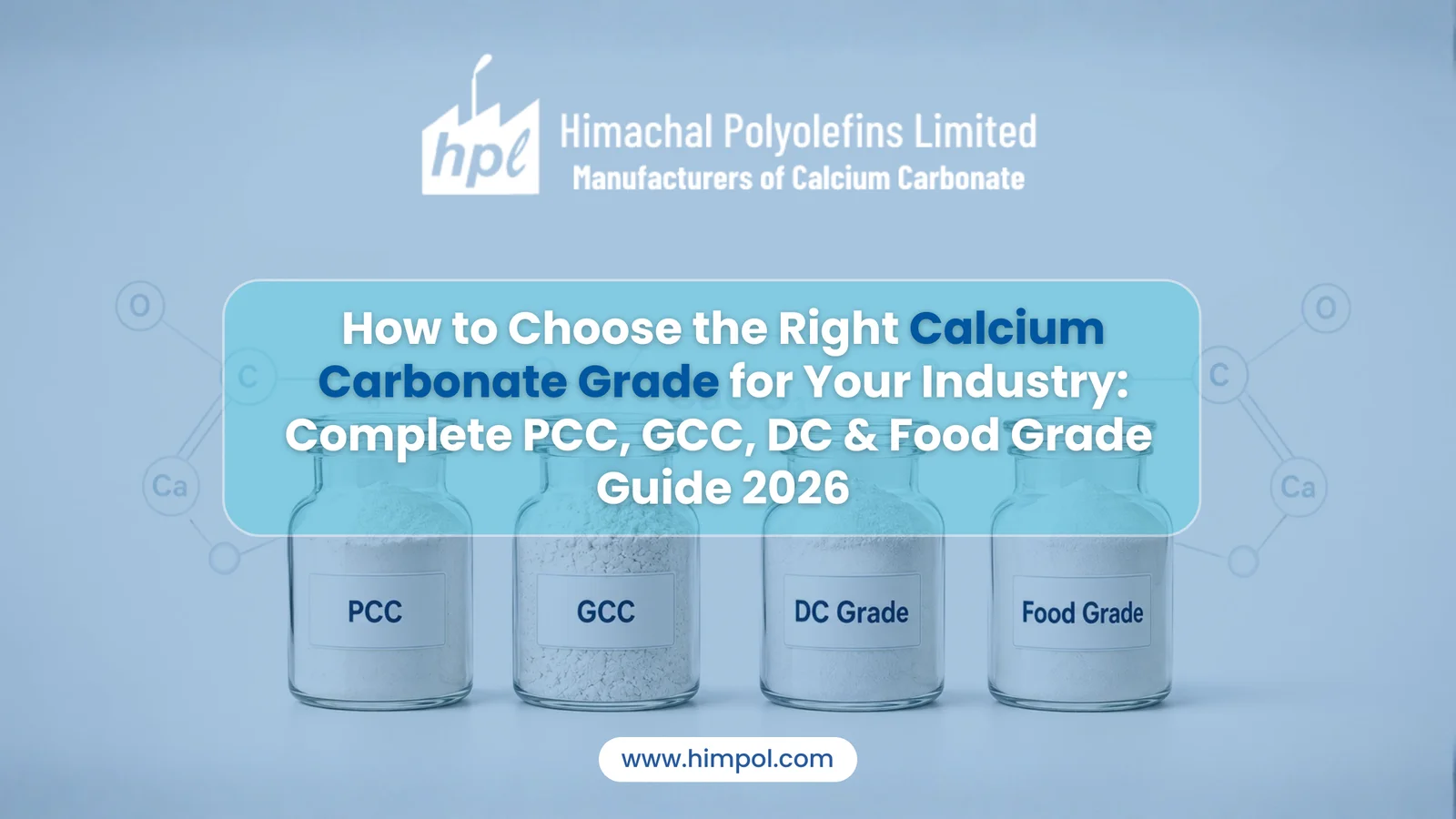
There are 4 main calcium carbonate grades: PCC (Precipitated), GCC (Ground), DC (Direct Compressible), and Food Grade. PCC offers highest purity for pharma and oral care applications. GCC is cost-effective for plastics and rubber. DC Grade is specifically designed for pharmaceutical tablets. Food Grade meets FSSAI standards for food products. Choose based on your industry’s purity, particle size, and certification needs.
What Is Calcium Carbonate and Why Does Grade Matter?
Calcium carbonate (CaCO₃) is an inorganic salt used as a filler, reinforcement, and functional additive across multiple industries. While the chemical formula remains the same, processing methods create distinct grades with different properties.
Why grades differ:
- Production method: Synthetic (PCC) vs. natural grinding (GCC)
- Particle size: Nano-scale (PCC) vs. 2-20 micron (GCC)
- Purity level: Higher in PCC due to synthetic process
- Application fit: Each grade optimized for specific industries
Choosing the wrong grade means paying for unnecessary purity (wasted cost) or receiving insufficient performance (quality issues).
Calcium carbonate (CaCO₃) has 4 main grades. PCC = highest purity (pharma/oral care). GCC = economical (plastics/rubber). DC = tablet manufacturing. Food Grade = FSSAI-certified for food.
What Are the 4 Main Calcium Carbonate Grades?

Here’s a breakdown of each grade and its primary use:
- PCC (Precipitated Calcium Carbonate): Synthetic production via carbonation process, nano-scale particles, highest purity (92-96% brightness), ideal for pharmaceuticals, oral care, and specialty paper
- GCC (Ground Calcium Carbonate): Naturally ground limestone, 2-20 micron particle size, cost-effective (~30% cheaper than PCC), best for plastics, rubber, adhesives, and construction materials
- DC Grade (Direct Compressible): Specially formulated for pharmaceutical tablet manufacturing, excellent flowability for direct compression, ensures efficient tableting
- Food Grade: FSSAI-certified, zero heavy metals, safe for human consumption, used in fortified foods, nutraceuticals, and food additives
GCC vs PCC: What’s the Difference and Which Should You Choose?
This comparison table is critical for making the right selection:
GCC = economical, granular, better flow (ideal for PVC pipes >25 parts). PCC = purer, nano-scale, better impact strength (ideal for premium pharma/oral care). Choose GCC for volume filling, PCC for functional reinforcement.
Key takeaway: If you’re in the plastics industry looking for cost efficiency, GCC is your answer. For pharmaceutical or oral care applications requiring, purity, PCC is justified despite higher cost.
Which Calcium Carbonate Grade Is Best for Your Industry?
1. Pharmaceutical Industry
- Use: DC Grade (Direct Compressible)
- Why: Excellent flowability, direct compression, tableting efficiency
- Certifications needed: WHO GMP, ISO
2. Food Industry & Fortified Foods
- Use: Food Grade Calcium Carbonate
- Why: FSSAI-certified, zero heavy metals, safe consumption
- Certifications: FSSAI, ISO, Halal
3. Oral Care & Toothpaste Manufacturers
- Use: PCC (Precipitated)
- Why: Highest purity, brightness, gentle on teeth
- Note: Himachal Polyolefins Limited is the largest supplier of calcium carbonate to the Oral Care industry in India
4. Plastic & PVC Industry
- Use: GCC (Ground)
- Why: Cost-effective, improves stiffness, dimensional stability
- Particle size: 400-1500 mesh
5. Paint Industry
6. Paper Industry
7. Rubber & Adhesives
How to Select the Right Grade: 5-Step Process
Follow this simple workflow:
- Identify your industry (pharma, food, plastic, oral care, paint, paper)
- Determine purity requirements (food/pharma need highest purity)
- Check particle size needs (nano for premium applications, micron for volume filling)
- Verify certification requirements (FSSAI for food, WHO GMP for pharma)
- Compare cost vs performance (GCC economical, PCC premium for functional needs)
Key Benefits of Choosing the Right Grade
Selecting the correct calcium carbonate grade delivers:
- Optimized performance: Grade matches your application’s specific needs
- Cost efficiency: Avoid overpaying for unnecessary purity levels
- Regulatory compliance: Meet FSSAI, WHO GMP, and ISO standards
- Quality consistency: Himpol delivers batch-to-batch consistency
- Better end-product: Right grade = superior performance in final product
Cost Factors and Pricing Considerations
Understanding pricing helps you budget effectively:
- GCC is approximately 30% cheaper than PCC
- PCC is justified for premium applications (pharmaceuticals, oral care, specialty paper)
- Bulk pricing available from bulk calcium carbonate supplier in Mumbai
- Contact Himachal Polyolefins Limited for custom quotes based on volume requirements
Calcium Carbonate Industry Trends in 2026
The calcium carbonate market is growing rapidly across India and globally:
2026 Key Trends:
- Sustainability focus: GCC preferred for high-volume, cost-effective products
- Premium applications growth: PCC demand rising in pharma, oral care, specialty plastics
- Surface modification: PCC particles surface-modified for better polymer compatibility
- Nano-PCC adoption: Functional filler for reinforcement in smaller quantities
- Certification requirements: FSSAI, WHO GMP, ISO becoming mandatory for food/pharma applications
Why Choose Himachal Polyolefins Limited (Himpol) in Mumbai?
When you’re searching for a trusted calcium carbonate manufacturer in Mumbai | India, Himachal Polyolefins Limited stands out for these reasons:
5+ Decades of Manufacturing Excellence
Over 50 years dedicated solely to specialized calcium carbonate manufacturing
Complete Grade Portfolio
- PCC Calcium Carbonate manufacturer in Mumbai
- GCC Calcium Carbonate supplier in Mumbai
- DC Grade Calcium Carbonate manufacturer in India
- Food Grade Calcium Carbonate supplier in Mumbai
Industry Leadership
- Largest supplier of calcium carbonate to the Oral Care industry in India
- Leading supplier to Food and Pharmaceutical Manufacturers across India
Certifications You Can Trust
State-of-the-Art Manufacturing Facility
- Stainless steel machinery for purity assurance
- Manufacturing location: Kala Amb, Himachal Pradesh
- Branch offices: Mumbai, Delhi, Gujarat, Kolkata
Quality Standards
- Batch-to-batch consistency guaranteed
- High purity calcium carbonate manufacturer in India
- Zero heavy metals for food grade products
Bulk Supply Capability
Frequently Asked Questions
1. What is the difference between PCC and GCC calcium carbonate?
PCC (Precipitated) is synthetically produced with nano-scale particles and higher purity (92-96% brightness). GCC (Ground) is naturally ground limestone with 2-20 micron particles and is approximately 30% cheaper. Choose PCC for pharmaceuticals and oral care; choose GCC for plastics and rubber.
2. Which calcium carbonate grade is used in toothpaste?
PCC (Precipitated Calcium Carbonate) is used in toothpaste due to its highest purity, brightness, and gentle texture on teeth. Himachal Polyolefins Limited is the largest supplier of calcium carbonate to the Oral Care industry in India.
3. Which calcium carbonate is used for pharmaceutical tablets?
DC Grade (Direct Compressible) Calcium Carbonate is specifically designed for pharmaceutical tablets. It offers excellent flowability for direct compression, ensuring efficient and consistent tableting.
4. Is Food Grade Calcium Carbonate safe for food products?
Yes, Food Grade Calcium Carbonate from certified manufacturers like Himpol is completely safe. It meets FSSAI standards with zero heavy metals and compliant processing methods.
4. What certifications should a calcium carbonate manufacturer have?
For food and pharmaceutical applications, manufacturers must have FSSAI, WHO GMP, and ISO certifications. For international export, Halal certification is valuable. Himpol holds ISO, FSSAI, WHO GMP, and Halal certifications.
Get Your Custom Calcium Carbonate Solution Today
📞 Contact Himachal Polyolefins Limited Today
Trusted manufacturer of calcium carbonate in Mumbai | India
5+ decades of manufacturing excellence
All grades available: PCC, GCC, DC Grade, Food Grade
Certified: ISO, FSSAI, WHO GMP, Halal
Bulk supplier with export capability across India
Email: dm-himpolgmail-com
Branch Offices: Mumbai | Delhi | Gujarat | Kolkata
Manufacturing Plant: Kala Amb, Himachal Pradesh
Get Your Custom Quote Now
Download Product Brochure