Choosing the wrong calcium carbonate grade can directly affect your final product quality, processing performance and customer satisfaction.
For bulk buyers, calcium carbonate is not just a raw material. It can influence whiteness, texture, purity, flow, stability, strength, opacity and overall product consistency.
A grade that works for the paint industry may not be suitable for pharma, food, oral care or plastic applications. Similarly, a product selected only by price may create issues in particle size, moisture level, documentation or batch consistency.
That is why businesses need to understand calcium carbonate grade selection before placing bulk orders.
Whether you are looking for a calcium carbonate manufacturer in Mumbai, a calcium carbonate supplier in India, or a calcium carbonate manufacturer near me, the right decision starts with knowing your application requirement.
Himachal Polyolefins Limited, also known as HIMPOL, helps industries choose suitable calcium carbonate solutions based on grade, purity, documentation and application suitability.
The right calcium carbonate grade depends on your industry, purity requirement, particle size, processing need, documentation and final product performance.
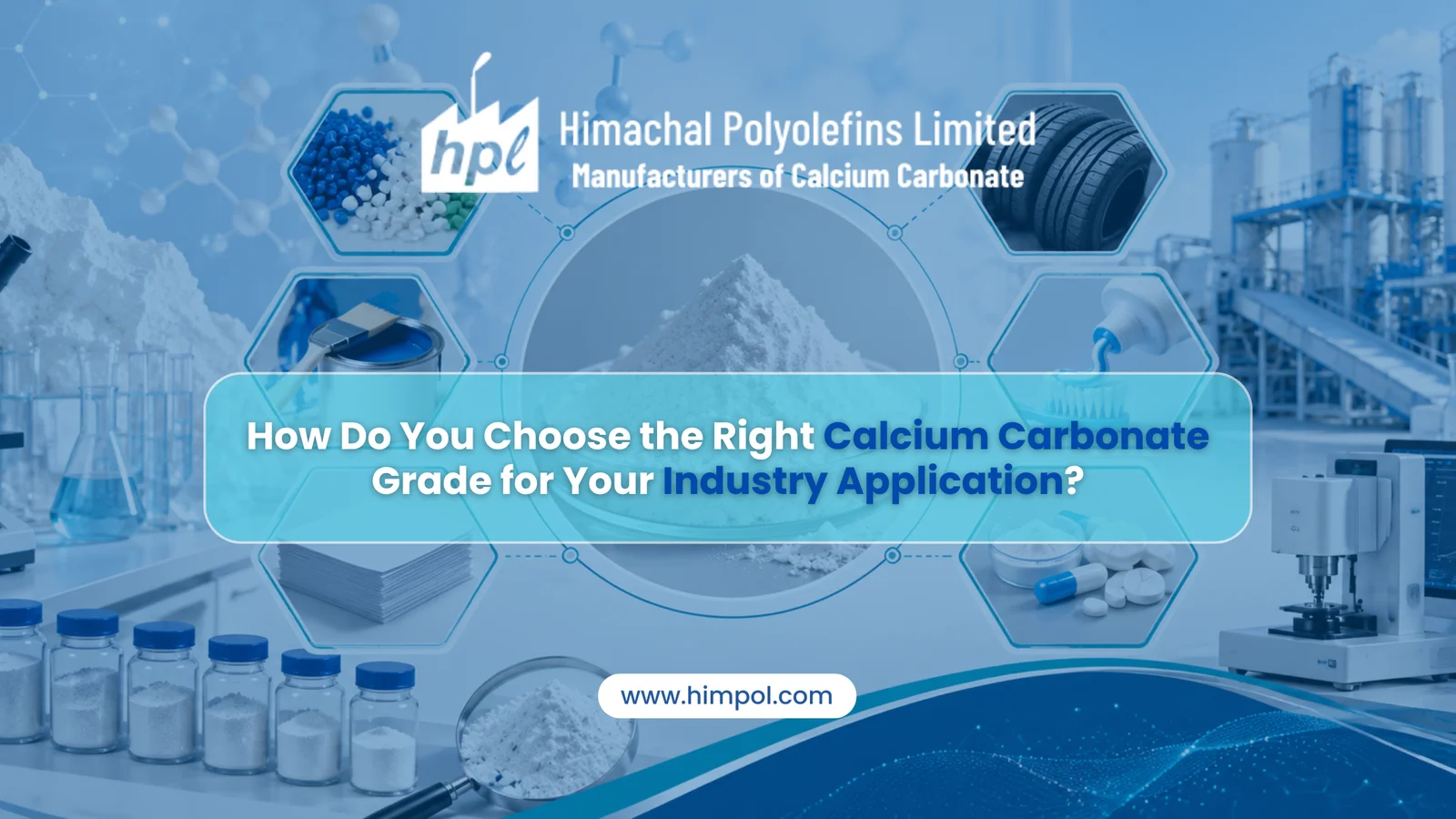
To choose the right calcium carbonate grade, check your industry application, required purity, particle size, moisture level, whiteness, documentation and bulk supply consistency. Food, pharma, plastics, paints, paper, rubber and oral care industries need different grades such as PCC calcium carbonate, GCC calcium carbonate, coated, uncoated, food grade calcium carbonate, pharma grade or DC grade calcium carbonate.
What Is Calcium Carbonate Grade Selection?
Calcium carbonate grade selection is the process of choosing the most suitable type of calcium carbonate for a specific industrial application.
Calcium carbonate is available in different forms, including precipitated calcium carbonate, ground calcium carbonate, coated calcium carbonate, uncoated calcium carbonate, food grade calcium carbonate, pharma grade calcium carbonate and DC grade calcium carbonate.
Each grade has different quality parameters such as:
- Calcium carbonate purity
- Calcium carbonate particle size
- Calcium carbonate whiteness
- Calcium carbonate moisture content
- Surface treatment
- Flow properties
- Documentation and compliance
- Calcium carbonate application suitability
For example, calcium carbonate for toothpaste requires controlled purity and smoothness. Calcium carbonate for plastic industry applications may need specific particle size and coating. Calcium carbonate for pharma industry applications may require documentation, safety standards and consistency.
Why Choosing the Right Calcium Carbonate Grade Matters
Selecting the correct grade is important because calcium carbonate affects both manufacturing and final product performance.
Key reasons include:
- Product quality: The wrong grade can affect smoothness, brightness, strength and stability.
- Processing efficiency: Correct particle size helps improve mixing, flow and dispersion.
- Regulatory safety: Food, pharma and oral care industries need safe and well-documented grades.
- Batch consistency: Bulk buyers need the same quality from batch to batch.
- Cost control: The cheapest material may increase rejection, wastage or production issues.
- Final application fit: Paints, plastics, paper, rubber, cosmetics and nutraceuticals need different specifications.
For calcium carbonate for bulk buyers, the focus should not be only on price. The right calcium carbonate bulk supplier should support technical clarity, documentation and regular supply.
Grade selection matters because every industry uses calcium carbonate differently. The right grade improves quality, while the wrong grade can affect production and performance.
How to Choose Calcium Carbonate Grade Step by Step?

Follow this simple process before finalizing your order.
Step 1: Identify Your Industry Application
First, define where the material will be used.
Common calcium carbonate industrial applications include:
- Calcium carbonate for food industry
- Calcium carbonate for pharma industry
- Calcium carbonate for oral care
- Calcium carbonate for toothpaste
- Calcium carbonate for plastics industry
- Calcium carbonate for paints
- Calcium carbonate for paper industry
- Calcium carbonate for rubber industry
- Calcium carbonate for nutraceuticals
- Calcium carbonate for cosmetics
Each application needs a different level of purity, particle size and documentation.
Step 2: Choose Between PCC and GCC
PCC calcium carbonate and GCC calcium carbonate are both widely used, but they are not the same.
Precipitated calcium carbonate, also called PCC, is manufactured through a controlled process. It offers better control over particle size, shape and purity.
Ground calcium carbonate, also called GCC, is produced by grinding natural limestone or calcite. It is commonly used in plastics, paints, rubber, paper and construction-related applications.
Step 3: Check Particle Size
Calcium carbonate particle size affects dispersion, smoothness, opacity, texture and processing.
Fine particle size may be useful for applications needing smooth finish and better surface quality. Coarser grades may be suitable where bulk filling or structural support is required.
Step 4: Review Purity and Whiteness
High purity calcium carbonate is important for food, pharma, oral care and cosmetics.
Calcium carbonate whiteness is especially important for paints, paper, toothpaste, plastics and premium products where final appearance matters.
Step 5: Ask for Documentation
A trusted manufacturer of calcium carbonate in India should provide required documentation based on the industry.
Important documents may include:
- Calcium carbonate certificate of analysis
- Product specification sheet
- Safety data sheet
- Food or pharma-related documentation, if applicable
- Batch quality details
- Compliance and certification support
Step 6: Test Before Bulk Ordering
Before placing a large order, sample testing is recommended.
Testing helps confirm calcium carbonate application suitability before full-scale production.
Benefits of Choosing the Right Calcium Carbonate Grade
The right grade can help manufacturers improve both process and product results.
Key benefits include:
- Better product finish
- Improved whiteness and brightness
- Smooth texture and dispersion
- Better processing in plastics and rubber
- Improved opacity in paints and paper
- Better stability in food products
- Suitable quality for pharma and nutraceutical formulations
- Reduced batch variation
- Better documentation support
- Fewer production issues during bulk supply
For industries depending on regular production, calcium carbonate consistency is one of the most important buying factors.
PCC vs GCC: Which One Should You Choose?
| Factor | PCC Calcium Carbonate | GCC Calcium Carbonate |
|---|---|---|
| Full Form | Precipitated Calcium Carbonate | Ground Calcium Carbonate |
| Production | Controlled manufacturing process | Mechanical grinding of natural limestone or calcite |
| Particle Control | More controlled particle size and shape | Depends on grinding and natural source |
| Common Use | Pharma, food, oral care, plastics, paints, paper | Plastics, paints, paper, rubber, construction and industrial uses |
| Purity | Usually selected where higher control is needed | Suitable for many bulk industrial applications |
| Cost Factor | May cost more due to processing control | Often more economical for bulk filler use |
| Best For | Applications needing purity, fine particle control and performance | Applications needing bulk volume, filling and cost efficiency |
PCC vs GCC selection depends on your product requirement. Buyers searching for gcc vs pcc or pcc vs gcc should not choose based on name alone. They should check performance, grade, quality parameters and end-use suitability.
Choose PCC when controlled purity, particle size and performance are important. Choose GCC when the application needs reliable bulk filling, cost efficiency and industrial performance.
Who Needs the Right Calcium Carbonate Grade?
The right grade is important for manufacturers, procurement teams and R&D teams.
You may need application-based grade selection if you belong to:
- Food manufacturing companies
- Pharmaceutical and nutraceutical companies
- Toothpaste and oral care brands
- Plastic compounding units
- Paint and coating manufacturers
- Paper manufacturers
- Rubber product manufacturers
- Cosmetic product manufacturers
- Animal nutrition companies
- Bulk industrial raw material buyers
If you are searching for a calcium carbonate supplier near me or calcium carbonate manufacturer near me, make sure the supplier understands your industry requirement, not just your order quantity.
Cost and Pricing Factors in Calcium Carbonate Selection
Calcium carbonate pricing depends on multiple factors. The cheapest grade is not always the most suitable grade.
Common pricing factors include:
- Type of calcium carbonate: PCC, GCC, coated or uncoated
- Purity level required
- Particle size requirement
- Food grade, pharma grade or industrial grade need
- DC grade calcium carbonate requirements
- Surface treatment or coating
- Quantity and packaging
- Documentation and compliance support
- Logistics and supply location
- Regular bulk supply requirement
For buyers in Mumbai, India, choosing a calcium carbonate supplier in Mumbai can help with faster coordination, location advantage and better supply planning.
Calcium carbonate cost depends on grade, purity, particle size, documentation, coating, quantity and logistics. Always compare value, not only price.
Industry Trends in 2026

In 2026, calcium carbonate demand is being shaped by performance, purity and application-specific requirements.
Important trends include:
- Growing demand from plastics, paper, paints, construction, food and pharma industries
- Increased focus on particle size distribution and surface-treated grades
- Rising need for high purity calcium carbonate in food, pharma, oral care and cosmetics
- More buyers asking for calcium carbonate quality testing before bulk orders
- Higher demand for reliable calcium carbonate manufacturer for bulk supply
- More focus on documentation, safety standards and batch consistency
- Growing interest in PCC and GCC comparison before procurement
- Increased use of calcium carbonate in toothpaste, nutraceuticals and food fortification applications
Why Choose Himachal Polyolefins Limited in Mumbai, India?
Himachal Polyolefins Limited, also known as HIMPOL or Himachal Polyolefins Ltd, is a trusted calcium carbonate company in India serving multiple industries.
The brand is known as a manufacturer of calcium carbonate in India with product categories such as:
- Precipitated Calcium Carbonate
- Ground Calcium Carbonate
- Food Grade Calcium Carbonate
- Direct Compressible Grade Calcium Carbonate
- Coated calcium carbonate
- Uncoated calcium carbonate
Businesses searching for Himachal Polyolefins Limited, Himachal Polyolefins, HIMPOL, Himachal Polyolefins Limited Kala Amb, or Himachal Polyolefins Limited | manufacturer of calcium carbonate in Mumbai | India are usually looking for a reliable manufacturer with product knowledge and bulk supply capability.
HIMPOL supports industries such as food, pharma, oral care, plastics, paints, paper, rubber, cosmetics and nutraceuticals.
Why bulk buyers choose HIMPOL:
- Application-focused calcium carbonate grade selection
- Support for PCC calcium carbonate and GCC calcium carbonate requirements
- Food, pharma and oral care industry understanding
- Quality-focused manufacturing approach
- Documentation support for industrial buyers
- Reliable supply for bulk requirements
- Experience across multiple calcium carbonate applications
- Strong presence as a calcium carbonate manufacturer in Mumbai | India
Buyers can also review Himachal Polyolefins Limited photos, product details and company information before making procurement decisions.
FAQs on Calcium Carbonate Grade Selection
1. How do I choose the right calcium carbonate grade?
Choose the grade based on your industry, purity requirement, particle size, moisture level, whiteness, documentation and final product application. For bulk orders, sample testing is recommended before full production use.
2. Which calcium carbonate grade is best for food industry applications?
Food grade calcium carbonate is suitable for food industry applications. It should be selected based on safety, purity, documentation, regulatory requirement and application, such as fortification, anti-caking or texture improvement.
3. What is the difference between PCC and GCC calcium carbonate?
PCC, or precipitated calcium carbonate, is produced through a controlled manufacturing process and offers better particle control. GCC, or ground calcium carbonate, is made by grinding natural limestone or calcite and is widely used in bulk industrial applications.
4. Why does particle size matter in calcium carbonate?
Calcium carbonate particle size affects smoothness, dispersion, opacity, texture, strength and processing. Different industries need different particle sizes depending on the final product requirement.
5. How do I find a reliable calcium carbonate manufacturer in India?
Look for a manufacturer with industry experience, quality control, product range, documentation support, sample testing, bulk supply capacity and application knowledge. Himachal Polyolefins Limited is a trusted calcium carbonate manufacturer in India serving multiple industries from Mumbai, India.
Conclusion
Looking for the right calcium carbonate grade for your industry application?
Connect with Himachal Polyolefins Limited, a trusted calcium carbonate manufacturer in Mumbai | India, for PCC calcium carbonate, GCC calcium carbonate, food grade calcium carbonate, pharma grade calcium carbonate and DC grade calcium carbonate solutions.
Choose the right grade. Improve product quality. Source confidently with HIMPOL.