Introduction
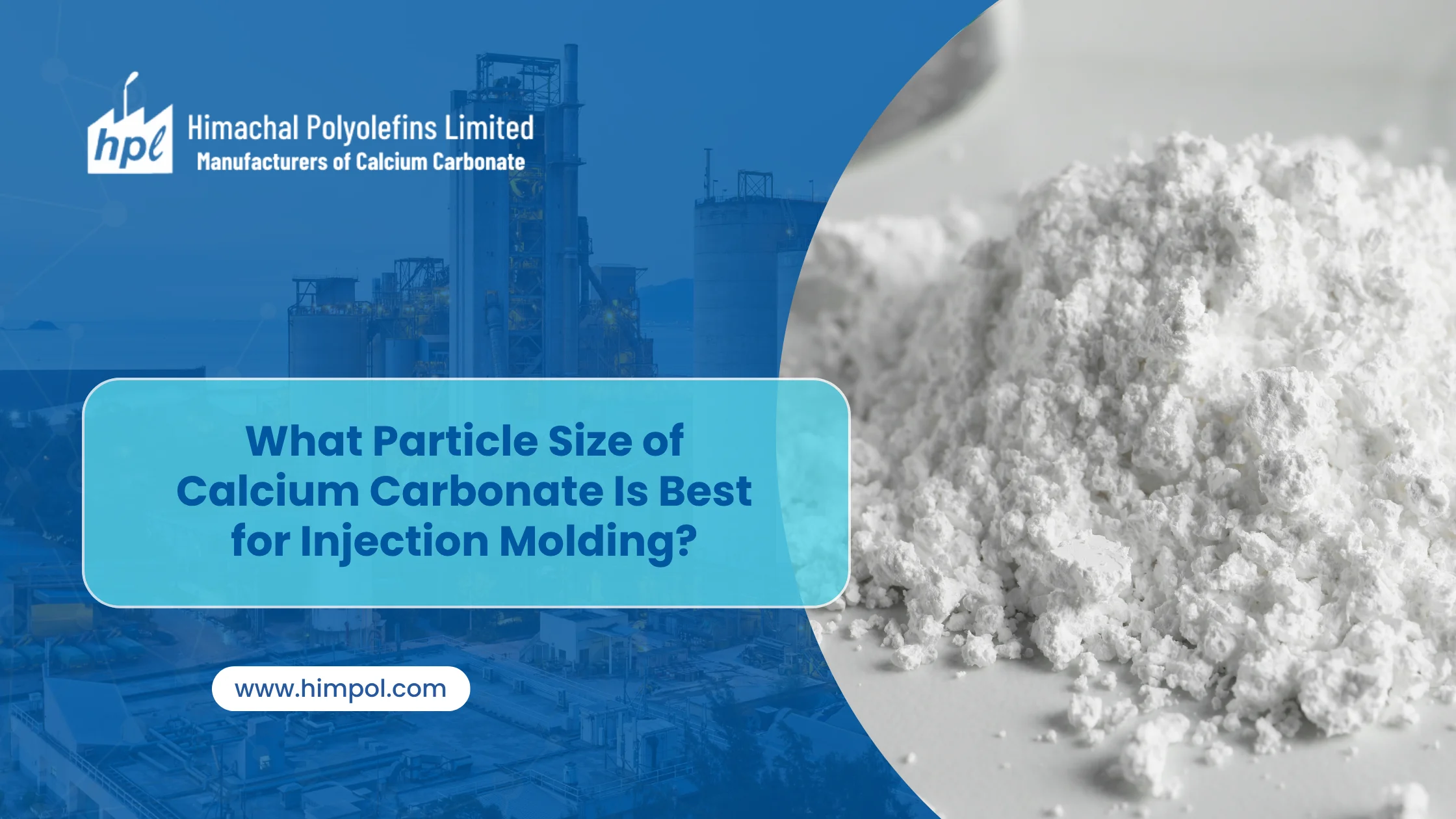
In the plastic manufacturing world, especially injection molding, choosing the right filler can make or break product quality. Many manufacturers struggle with issues like poor surface finish, weak strength, higher costs, or inconsistent processing. Often, the root cause is overlooked—particle size of calcium carbonate.
Whether you’re producing automotive components, household plastics, or packaging materials in Mumbai, selecting the correct grade is crucial. A mismatch in particle size can lead to defects like brittleness, poor dispersion, or increased cycle time.
As a trusted manufacturer of calcium carbonate in india, Himachal Polyolefins Limited understands how critical this decision is. In this guide, we’ll break down everything you need to know—simply, practically, and with real industry insights.
Featured Snippet
The best particle size of calcium carbonate for injection molding typically ranges between 1 to 5 microns. Fine particles improve surface finish and strength, while slightly coarser grades reduce cost and enhance processability. The ideal size depends on the application, polymer type, and required product performance.
What is Particle Size of Calcium Carbonate in Injection Molding?
Particle size refers to the diameter of calcium carbonate particles used as fillers in plastic compounds. It is usually measured in microns (µm).
In injection molding, this parameter directly impacts:
- Flow behavior
- Surface finish
- Mechanical strength
- Processing efficiency
Mini Summary Box:
Smaller particles = Better finish & strength
Larger particles = Lower cost & easier processing
Why Does Particle Size Matter in Injection Molding?
Choosing the wrong particle size can lead to performance issues.
Key Reasons:
- Improves dispersion in polymers
- Enhances surface smoothness and gloss
- Affects mechanical properties like tensile strength
- Controls shrinkage and dimensional stability
- Impacts cycle time and mold flow
Mini Summary Box:
Right size = Better quality + cost efficiency
Wrong size = Defects + production loss

How Particle Size Works in Injection Molding (Step-by-Step)
Step 1: Mixing
Calcium carbonate is blended with polymer resins (PP, PE, PVC).
Step 2: Melting
The mixture is heated and becomes molten.
Step 3: Flow into Mold
Fine particles improve flow and reduce resistance.
Step 4: Cooling & Solidification
Uniform particle size ensures consistent structure.
Step 5: Final Product
Surface finish and strength depend on particle distribution.
Mini Summary Box:
Uniform particle size = Uniform product quality
Best Particle Size Range for Injection Molding
Recommended Sizes:
- 1–2 microns → High-end products, smooth finish
- 2–3 microns → Balanced performance & cost
- 3–5 microns → Cost-effective, bulk production
Application-Based Selection:
- Automotive parts → 1–2 microns
- Household plastics → 2–3 microns
- Packaging → 3–5 microns
Mini Summary Box:
Ideal range: 1–5 microns depending on use
Benefits of Using the Right Particle Size
- Improves surface finish and gloss
- Enhances impact strength
- Reduces material cost
- Improves processing speed
- Increases dimensional stability
- Better compatibility with plastic polymers
Mini Summary Box:
✔ Better performance
✔ Lower cost
✔ Faster production
Comparison with Alternatives
| Property | Fine Calcium Carbonate (1–2µm) | Coarse Calcium Carbonate (3–5µm) | Talc | Glass Fiber |
|---|---|---|---|---|
| Surface Finish | Excellent | Moderate | Good | Rough |
| Cost | Medium | Low | Medium | High |
| Strength | High | Moderate | Moderate | Very High |
| Processability | Good | Excellent | Moderate | Complex |
| Weight | Light | Light | Light | Heavy |
Mini Summary Box:
Calcium carbonate offers the best balance of cost + performance
Who Needs the Right Particle Size?
This is critical for:
- Plastic injection molding manufacturers
- Automotive component producers
- Packaging companies
- Household plastic product manufacturers
- PVC and polymer compounders
If you operate in Mumbai’s fast-paced plastic industry, optimizing filler selection can give you a strong competitive edge.
Mini Summary Box:
Ideal for anyone focused on quality + cost efficiency
Cost / Pricing Factors
The cost depends on:
- Particle size (finer = higher cost)
- Purity level
- Surface treatment (coated vs uncoated)
- Bulk quantity
- Supplier reliability
In Mumbai, bulk sourcing from a reliable calcium carbonate in india helps reduce costs significantly.
Mini Summary Box:
Smaller size = Higher cost but better quality
Industry Trends in 2026
The calcium carbonate industry is evolving rapidly.
Key Trends:
- Shift towards ultrafine PCC grades
- Increased demand in automotive lightweight plastics
- Focus on eco-friendly fillers
- Growth of high-performance polymer compounds
- Smart manufacturing in Mumbai & across India
Data Insight:
The global calcium carbonate market is projected to grow at 5–6% CAGR by 2026, driven by plastics and packaging demand.
Mini Summary Box:
Future = Fine particles + high-performance plastics
Why Choose Himachal Polyolefins Limited in Mumbai?
When it comes to quality and reliability, Himachal Polyolefins Limited stands out among calcium carbonate manufacturers in India.
Why Choose Us:
- Advanced manufacturing technology
- Consistent particle size distribution
- Custom grades for injection molding
- Trusted by industries across Mumbai
- Competitive pricing with bulk supply
We are a leading precipitated calcium carbonate manufacturers in India, delivering high-performance solutions for the calcium carbonate for plastic industry.
Mini Summary Box:
Trusted quality + consistent supply
FAQs (People Also Ask)
1. What is the ideal particle size for calcium carbonate in plastics?
The ideal range is 1–5 microns, depending on product requirements.
2. Does smaller particle size improve strength?
Yes, finer particles improve dispersion and mechanical strength.
3. Is coated calcium carbonate better for injection molding?
Yes, coated grades improve compatibility with polymers and performance.
4. Which industries use calcium carbonate in injection molding?
Automotive, packaging, consumer goods, and PVC industries.
5. How to choose the right supplier in Mumbai?
Look for consistency, certifications, and experience like Himachal Polyolefins Limited.
Strong CTA
Looking to improve your injection molding quality while reducing costs?
Partner with Himachal Polyolefins Limited, a leading manufacturer of calcium carbonate in india, delivering precision-engineered solutions in Mumbai.
Contact us today to get the right particle size for your application
Boost your product quality. Reduce costs. Scale smarter.