If you are searching for reliable Manufacturers calcium carbonate in Mumbai India, checking price and particle size alone may not tell you how the material will behave inside your formulation. One technical value that deserves attention is oil absorption value.
Why? Because calcium carbonate does more than occupy space in paints, coatings, plastics, rubber, sealants and other formulations. Its surface characteristics can influence how much binder, oil or plasticizer is required to wet and incorporate the mineral.
For example, two calcium carbonate grades may look similar on a specification sheet. However, if their oil absorption values are different, they may behave differently during mixing. One may increase binder demand or viscosity while another may allow higher mineral loading with easier processing.
Therefore, buyers working with a Calcium carbonate manufacturer in Mumbai India should understand what oil absorption means before approving a grade
For manufacturers, formulators and procurement teams, this small specification can provide useful information about processing behaviour, formulation efficiency and batch consistency. Why Does Oil Absorption Value Matter in Calcium Carbonate?
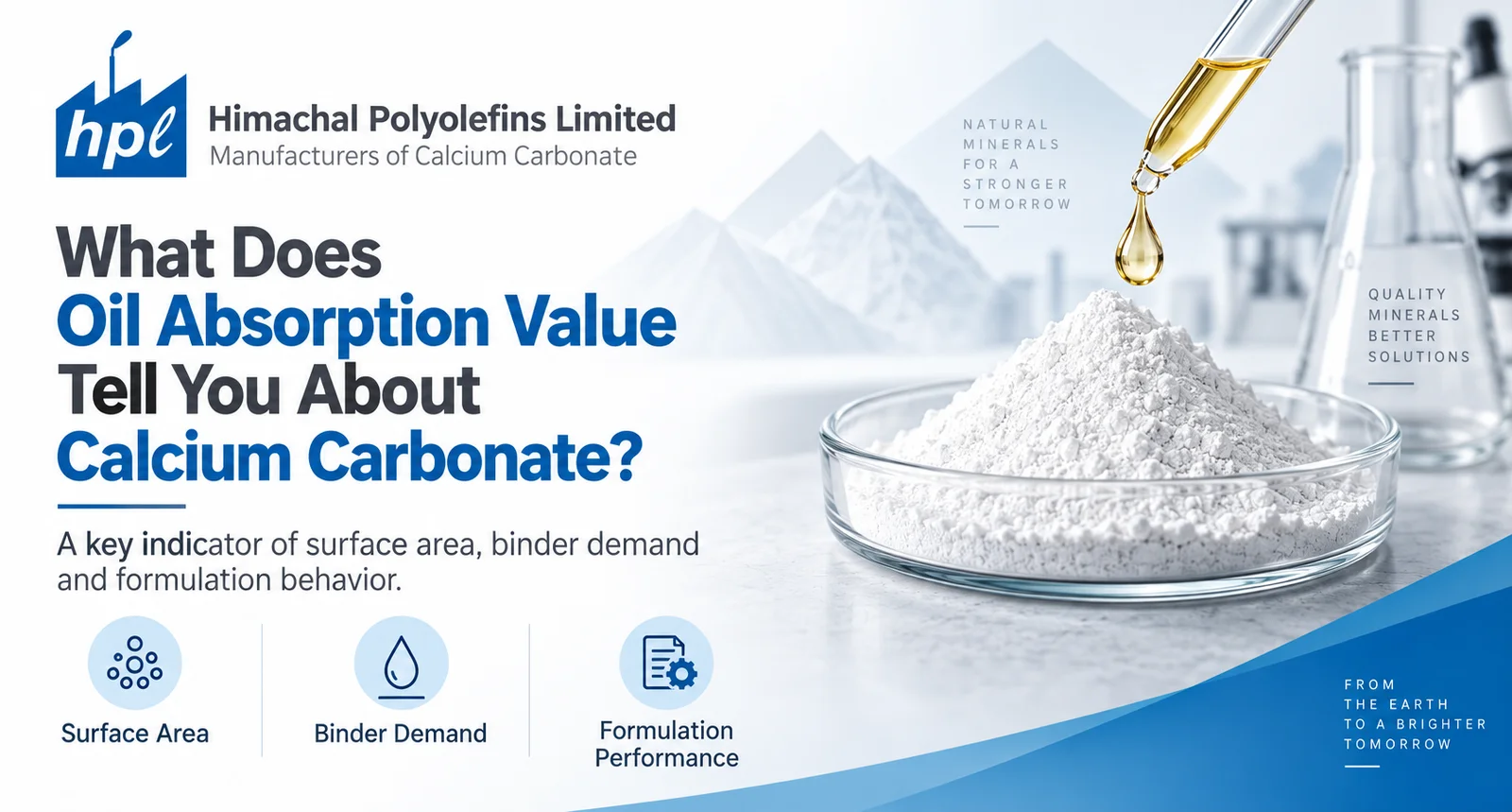
Oil absorption value shows how much oil a calcium carbonate sample absorbs under defined test conditions. It can provide useful information about particle surface characteristics and formulation demand. A higher value may require more binder or plasticizer while a lower value may support easier processing depending on the application and formulation.
What Is Oil Absorption Value in Calcium Carbonate?
Oil absorption value is the quantity of oil absorbed by a pigment or extender under defined test conditions.
The current ISO 787-5:2026 standard defines oil absorption value as the amount of refined linseed oil absorbed by a pigment or extender sample under specified conditions. The result can be expressed on a volume-to-mass or mass-to-mass basis.
In practical terms, the test helps formulators understand how much liquid is required to wet the mineral and form a consistent paste.
Oil absorption is influenced by several characteristics, including:
- Particle size distribution
- Particle shape
- Surface area
- Porosity
- Agglomeration
- Surface treatment
- Mineral structure
Therefore, oil absorption should not be viewed as a simple measure of particle size alone.
For buyers comparing a Precipitated Calcium Carbonate Manufacturer in India with a GCC supplier, this value can help explain why different grades behave differently even when their average particle sizes appear similar.
Why Is Oil Absorption Value Important When Selecting Calcium Carbonate?
Oil absorption matters because it can influence how calcium carbonate interacts with the liquid phase of a formulation.
Key reasons include:
- Binder demand: A grade with higher oil absorption may require more binder to wet the particles.
- Viscosity: Changes in oil absorption can affect formulation thickness and flow.
- Mineral loading: Lower oil demand may support higher filler loading in some systems.
- Processing behaviour: Material that is easier to wet and disperse may simplify mixing.
- Formulation cost: Higher binder or plasticizer requirements can influence total formulation economics.
- Consistency: Stable oil absorption from batch to batch can help manufacturers maintain predictable processing.
- Grade selection: Oil absorption can help distinguish calcium carbonate grades designed for different end uses.
However, higher or lower is not automatically better. The correct value depends on the formulation.
For example, a coatings producer may have very different requirements from a pharmaceutical business buying Direct Compressible (DC) Grade Calcium Carbonate.
Oil absorption value helps formulators understand how calcium carbonate interacts with oils, binders or similar liquid components. The right value depends on the final product, processing conditions and desired performance.
How Is Oil Absorption Value Tested and Used Step by Step?

Step 1: Take a Representative Sample
First, a representative calcium carbonate sample is selected.
Consistent sampling matters because moisture, agglomeration or batch variation can influence test results.
Step 2: Add Oil Under Controlled Conditions
Refined linseed oil is gradually added to the mineral sample.
ISO 787-5:2026 specifies a general test method for determining oil absorption in pigments and extenders. The updated 2026 edition also includes defined conditioning parameters and methods for expressing the result.
Step 3: Mix Until a Defined Paste Is Formed
The oil and mineral are mixed until the test reaches the required endpoint.
The purpose is to determine how much oil is needed for the powder particles to become sufficiently wetted under controlled conditions.
Step 4: Calculate the Oil Absorption Value
The oil quantity is related to the mass of the tested mineral.
ISO documentation notes that results may be expressed in relation to the amount of product tested.
Step 5: Compare the Result With the Application Requirement
Finally, the number is compared with the specification for the intended application or with an agreed reference sample.
This step is important. A number has little value without knowing what the formulation actually requires.
What Are the Benefits of Checking Oil Absorption Value?
Reviewing oil absorption before approving a calcium carbonate grade can help manufacturers:
- Predict binder or plasticizer demand more effectively
- Maintain more stable viscosity
- Improve raw material consistency
- Compare GCC and PCC grades more meaningfully
- Reduce unnecessary formulation adjustments
- Improve mineral loading decisions
- Identify unexpected batch variation
- Support more predictable mixing and dispersion
For a business sourcing from a Calcium carbonate powder supplier in Mumbai India these benefits can be especially valuable when production is continuous and raw material consistency is important.
Oil Absorption vs Other Calcium Carbonate Parameters: What Is the Difference?
Oil absorption should not be used alone. It works best when considered alongside other specifications.
| Parameter | What It Tells You | Why It Matters |
|---|---|---|
| Oil Absorption Value | How much oil is absorbed under defined conditions | Helps assess binder demand and formulation behaviour |
| Particle Size Distribution | Range and distribution of particle sizes | Influences dispersion, surface finish and processing |
| Whiteness | Visual whiteness of the mineral | Important for appearance-sensitive applications |
| Bulk Density | Mass of powder per unit bulk volume | Affects handling, storage and dosing |
| Moisture | Water present in the powder | Can influence flow, storage and processing |
| Purity | Chemical composition and unwanted impurities | Important for technical and regulated applications |
A Ground Calcium Carbonate Manufacturer in Mumbai , India may offer several GCC grades with different properties. Similarly, Precipitated calcium carbonate manufacturers in India may control particle morphology and other characteristics through the production process.
The best grade is therefore the one that matches the full application requirement rather than one specification in isolation.
Who Needs to Check Oil Absorption Value?
Oil absorption can be relevant for technical teams working with calcium carbonate in:
- Paints and coatings
- Plastics and masterbatch
- Rubber compounds
- Sealants and adhesives
- PVC formulations
- Printing inks
- Construction materials
- Industrial compounds
It is particularly useful for formulators who are adjusting filler loading, binder demand or viscosity.
Other calcium carbonate applications may require different priorities. A Food-grade calcium carbonate manufacturer in Mumbai, for example, may need to focus strongly on purity, regulatory requirements and application-specific quality parameters.
Likewise, businesses sourcing from a DC Grade Calcium Carbonate Manufacturer in India may prioritize flow, compressibility, purity and tablet manufacturing requirements.
What Factors Affect Calcium Carbonate Cost and Formulation Cost?
The purchase price of calcium carbonate is only one part of the total formulation cost.
Several factors can influence commercial value:
- GCC or PCC grade
- Particle size requirements
- Surface treatment
- Purity
- Oil absorption specification
- Whiteness
- Processing requirements
- Packaging
- Order volume
- Quality documentation
- Transportation
Oil absorption can also influence indirect formulation cost.
For instance, if a mineral grade requires more binder or plasticizer to achieve the desired consistency, the overall formulation may become more expensive even if the calcium carbonate itself has a lower purchase price.
Therefore, buyers comparing Calcium Carbonate Suppliers in Mumbai should consider processing efficiency and formulation economics alongside material price.
What Are the Calcium Carbonate Quality Trends in 2026?
In 2026, raw material buyers are paying increasing attention to measurable specifications rather than relying only on general grade names.
One notable development is the publication of ISO 787-5:2026, the second edition of the international standard for determining oil absorption value in pigments and extenders. It replaced the earlier 1980 edition and introduced updated testing details including conditioning requirements.
For industrial buyers, this reflects a broader focus on:
- Better-defined quality specifications
- Consistent test methods
- Batch-to-batch traceability
- Application-specific calcium carbonate grades
- More detailed technical documentation
- Greater attention to processing performance
As formulations become more tightly controlled, buyers increasingly need a Calcium carbonate manufacturer in India that can discuss material properties in technical terms rather than simply supplying powder.
Why Choose Himachal Polyolefins Limited (HIMPOL) in Mumbai, India?
Himachal Polyolefins Limited (HIMPOL) supplies calcium carbonate grades for a range of industrial requirements.
Businesses looking for Manufacturers calcium carbonate in Mumbai | India can discuss application requirements such as grade type, particle characteristics and intended use before selecting material.
The product portfolio includes:
- Precipitated Calcium Carbonate
- Ground Calcium Carbonate (GCC) in Mumbai | India
- Coated and uncoated GCC
- Direct Compressible (DC) Grade Calcium Carbonate
- Directly Compressible Calcium Carbonate Powder
- Pharmaceutical Grade DC Calcium Carbonate
- Food-grade calcium carbonate
- Application-specific calcium carbonate grades
Companies searching for a Manufacturer of Precipitated Calcium Carbonate in Mumbai | India, PCC Powder Manufacturer in India, High-Purity Precipitated Calcium Carbonate, Ground Calcium Carbonate Manufacturer in Mumbai or Ground Calcium Carbonate Suppliers in Mumbai can evaluate the grade according to their process and final-product needs.
The goal is simple: select calcium carbonate based on the application, not merely on the name of the grade.
FAQs
1. What does a high oil absorption value mean in calcium carbonate?
A higher oil absorption value means the calcium carbonate requires more oil under the specified test conditions. In a formulation, this may indicate higher binder or plasticizer demand. However, the effect depends on the complete formulation.
2. Is lower oil absorption always better?
No. Lower oil absorption may help in applications requiring high mineral loading or lower binder demand but it is not automatically superior. The ideal range depends on processing conditions and required product performance.
3. Does particle size affect oil absorption?
Particle size distribution can influence oil absorption but it is not the only factor. Particle shape, surface area, porosity, aggregation and surface treatment can also affect the result.
4. Is oil absorption important for both GCC and PCC?
Yes. Oil absorption can provide useful formulation information for both GCC and PCC. However, their different particle characteristics mean values should be assessed against the intended application rather than compared in isolation.
5. Where can I find a calcium carbonate manufacturer in Mumbai, India?
Businesses seeking a Calcium carbonate manufacturer in Mumbai can connect with Himachal Polyolefins Limited (HIMPOL) for PCC, GCC, DC Grade, food-grade and other calcium carbonate requirements based on application needs.
Choose Calcium Carbonate Based on How It Performs
A calcium carbonate specification is more than a list of numbers. Oil absorption value can help you understand how a mineral may interact with binders, affect formulation behaviour and influence overall processing.
If you are evaluating Manufacturers calcium carbonate in Mumbai | India, discuss your end application and required technical parameters before finalizing a grade.
Connect with Himachal Polyolefins Limited (HIMPOL) in Mumbai, India to discuss the right calcium carbonate grade for your manufacturing requirements.
Think Calcium, Think HIMPOL.
For more information contact:
Himachal Polyolefins Limited | Manufacturer of Calcium Carbonate in Mumbai | India
Address: 1st Floor, Gate 2, Golden Tobacco House, Swami Vivekanand Rd, Navpada, Vile Parle West, Mumbai, Maharashtra 400056